God Was Training Us: Arthur and Emma Semmens in Australia
Gospel in Action
Two trained nurses went home to Australia hoping to care for the sick, and were asked to preach as well. What they learned became a model for joining the medical work and the ministry.
What God has joined
Jesus said of marriage, “What therefore God hath joined together, let not man put asunder” (Mark 10:9). The same principle runs through His ministry. “Jesus went about all the cities and villages, teaching in their synagogues, and preaching the gospel of the kingdom, and healing every sickness and every disease among the people” (Matt. 9:35). Teaching and healing were never two ministries in His hands. They were one.
In the 1890s the church in Australia set out to keep them together. Two of the people who showed how it could be done were a young nurse named Arthur Semmens and his wife, Emma.
A nurse from Battle Creek
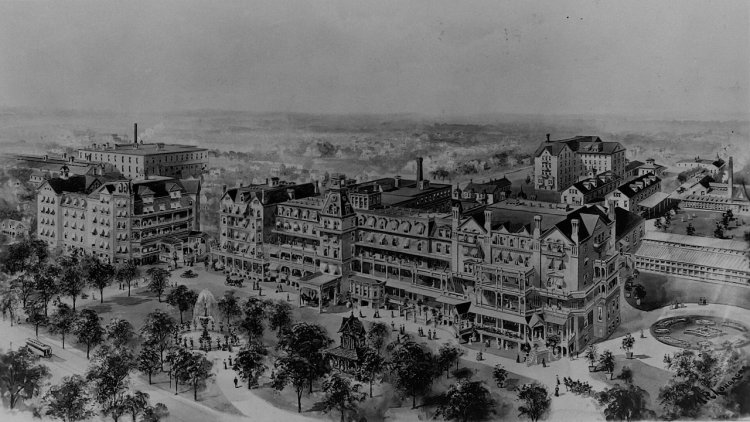
A. W. Semmens was a young Australian who trained as a nurse at the Battle Creek Sanitarium in Michigan. When Dr. Kellogg launched the Christian Help Bands there in November 1892, Semmens led “Christian Help Band No. 1.” These bands went out into the town to find people in need and help them with food, clothing, firewood, nursing and kind words.¹
By 1894 he was back in Australia, and Emma, also a trained nurse, worked beside him.² They came home at a hard time. In 1893 Australia’s banks had failed, and life savings were lost. Ellen White, then living in Australia, wrote that hardly a day passed without people coming to her door begging for food. “They are never turned away,” she added.³
Christian Help Bands in Melbourne
On Sabbath afternoon, May 12, 1894, the North Fitzroy church in Melbourne met to consider the Christian Help work. Elder A. G. Daniells led the meeting, and Brother Semmens told how the work was done in America. The bands had five objects: to minister to the sick, provide for the needy, comfort the distressed, uplift the fallen, and lead the unconverted to Christ. Between fifty and sixty members volunteered, and five bands of ten were organized. A member of the Fitzroy city council gave two guineas.⁴
The community noticed. Within weeks members of the city council were meeting with the band to help plan its work, and people outside the church promised support because, as one report put it, “they recognize in it the fruits of practical Christianity.”⁵ Five months after the start there were seven bands, each with its own district. The church’s missionary meetings were better attended than they had been for years; attendance had grown fourfold.⁶
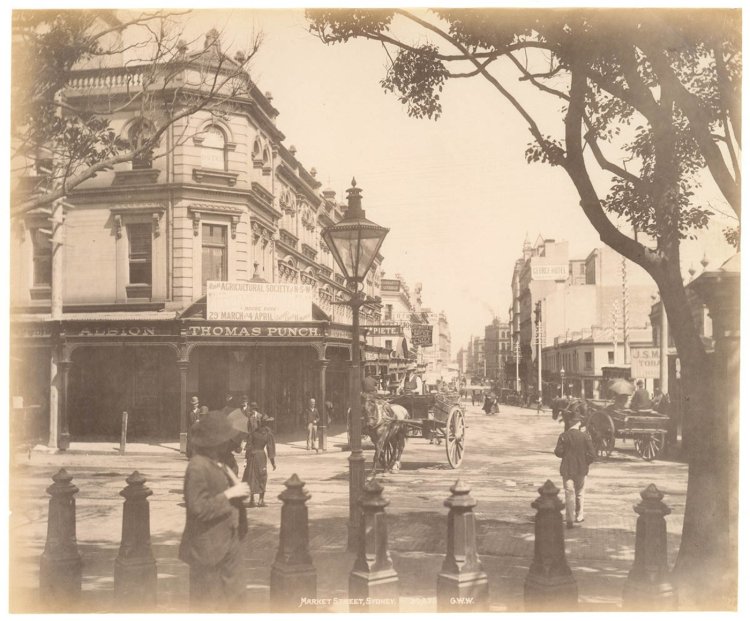
Fred Hardie, Market Street, Sydney (1893). Public domain.
Learning to give Bible readings
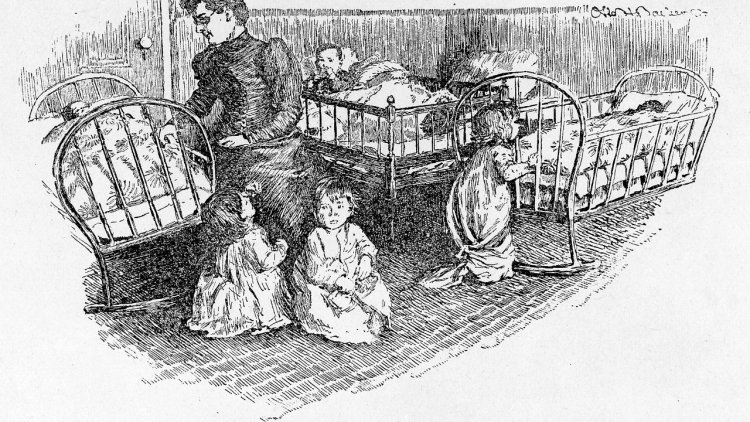
The Semmenses had trained to care for the sick, and they hoped that would be their main work. Instead the conference sent them to Sydney, where they joined Elder J. O. Corliss in tent meetings and Bible work. Arthur combined the work of a colporteur-evangelist with that of a missionary nurse. Under Corliss’s teaching he learned to give Bible readings, and before long he and a fellow worker were holding six or eight readings a week.⁷ W. C. White wrote that Semmens was “becoming one of the best Bible workers we have.”⁸
The learning went both ways. Corliss saw that his young partner could do things he could not. The people Semmens treated were grateful, and grateful people listen. When Corliss returned to America he took this lesson with him, and his work in Ottawa and later in San Francisco was built on it.⁹
Joined, not divided
Not everyone approved. Dr. Kellogg thought trained nurses should do nothing but medical work, and he was unhappy that Semmens was “so largely employed in evangelistic work.”¹⁰ W. C. White disagreed. He wrote that Kellogg’s criticism virtually said that people trained in health work must make it their only business, and in this, he said, Kellogg did what the General Conference had done: he was “putting asunder that which God has joined together.”¹¹
The Australian leaders kept the two works together. About 1896 Semmens, on the advice of his brethren, opened a health home in a seven-room cottage at Ashfield, a suburb of Sydney. W. C. White reported that there was very little to start with except the need and “the confidence of the people secured by Brother Semmens during two years of labor as a Bible worker and missionary nurse.” The Semmenses also taught church members practical hygiene and Christian Help work. Seeing what they had done, the other colonies began pleading for nurses and physicians of their own.¹²
A pattern for the church
When the General Conference met in 1901, A. G. Daniells used Semmens to explain the Australian approach. When Semmens arrived, Daniells said, he had not known how to start him in medical work. Some of the brethren suggested, “Let us make him a preacher and a medical worker combined,” supported from the tithe, teaching “the principles of health and temperance, and of the gospel in all its branches.”¹³
Four days later Ellen White wrote, “A gospel minister will be twice as successful in his work if he understands how to treat disease.”¹⁴ The Australian model had already shown it. In Newcastle, where the evangelistic and medical work were united, Dr. Edward Caro asked Elder Starr how the experiment had gone. “Splendid,” Starr replied. “The people themselves are unwilling that there should be a separation.” Caro summed up the lesson: “We want nurses who are Bible workers; and we want Bible workers and canvassers who are nurses.”¹⁵
“God was training us”
At the time, Arthur and Emma had not understood why they could not simply nurse. Years later Arthur looked back:
We did not then understand why we could not enter upon strictly medical work; we know now. God was training us, that we should not be one-sided workers, but have an all-around experience.¹⁶
That is the lesson of their story. Medical missionary work is the best way to take the gospel forward, but only when it stays joined to the gospel. Healing opened the doors in Melbourne and Sydney, and Bible readings led people through them. A nurse who could open the Scriptures, and a preacher who could relieve pain, did more together than either could alone.
Ellen White put it plainly: “Successful evangelistic work can be done in connection with medical missionary work. It is as these lines of work are united that we may expect to gather the most precious fruit for the Lord.”¹⁷
The call still stands for every believer: learn to help the body, and learn to open the Word. Do not let what God has joined be put asunder.
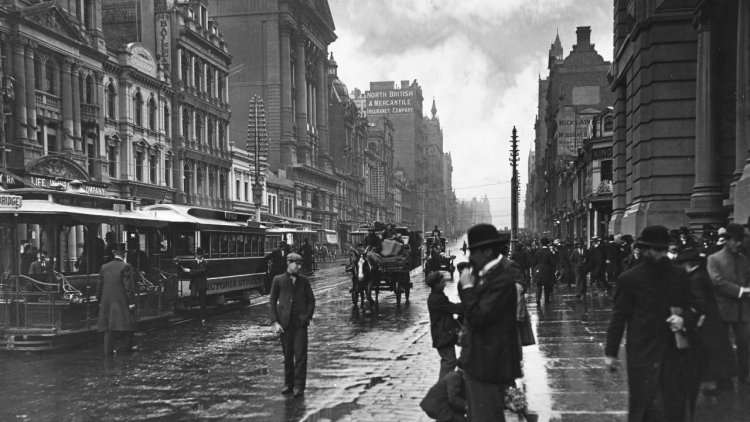
Cover picture: Fritz Kricheldorff (attributed), Collins Street, Melbourne, Looking West (c. 1890s). Public domain.
Notes
- Dave Fiedler, d’Sozo: Reversing the Worst Evil, 2nd ed. (Adventist City Missions, 2012), 56–59; The Medical Missionary, March/April 1893, 74–75.
- Fiedler, d’Sozo, 134, 136.
- Ellen G. White, Review and Herald, May 29, 1894, quoted in Fiedler, d’Sozo, 135.
- Bible Echo, May 28, 1894, quoted in Fiedler, d’Sozo, 134.
- J. O. Corliss, Review and Herald, July 24, 1894, quoted in Fiedler, d’Sozo, 135–136.
- Anna L. Ingels, Review and Herald, December 4, 1894, quoted in Fiedler, d’Sozo, 136.
- W. C. White to O. A. Olsen, August 20, 1895, quoted in Fiedler, d’Sozo, 136.
- W. C. White to Robert Hare, November 20, 1896, quoted in Fiedler, d’Sozo, 136.
- Fiedler, d’Sozo, 159–160.
- W. C. White to the Executive Committee of the Australasian Union Conference, August 11, 1896, quoted in Fiedler, d’Sozo, 138.
- W. C. White to A. G. Daniells, June 17, 1896, quoted in Fiedler, d’Sozo, 137–138.
- W. C. White, Review and Herald, June 22, 1897, 397, quoted in Fiedler, d’Sozo, 143.
- A. G. Daniells, General Conference Bulletin, April 7, 1901, 91–92, quoted in Fiedler, d’Sozo, 148.
- Ellen G. White, Manuscript Releases, vol. 14, 269, quoted in Fiedler, d’Sozo, 149.
- Edward Caro, Australasian Union Conference Record, July 2, 1899, quoted in Fiedler, d’Sozo, 142–143.
- A. W. Semmens, General Conference Bulletin, June 2, 1909, 284, quoted in Fiedler, d’Sozo, 141.
- Ellen G. White, Medical Ministry, 26.
Bibliography
Fiedler, Dave. d’Sozo: Reversing the Worst Evil. 2nd ed. Adventist City Missions, 2012.
General Conference Bulletin, April 7, 1901; June 2, 1909.
Review and Herald, July 24, 1894; December 4, 1894; June 22, 1897.
White, Ellen G. Manuscript Releases, vol. 14.
White, Ellen G. Medical Ministry. Pacific Press, 1932.
Take it further
Did this speak to you? Ask for more, or ask us to pray with you.
What's Your Reaction?
Comments 0
No comments yet. Be the first to share a thought.