"O Here Is Sister Louise!" A Nurse in the Slums of Chicago
Gospel in Action
History has kept only her first name. But in 1894 the children of Chicago’s worst streets ran to meet a missionary nurse they called Sister Louise, and her story crossed the world to show what medical missionary work can do.
“I was sick, and ye visited me”
Jesus described the judgment in terms of simple kindness: “I was sick, and ye visited me.” Those who did it will be surprised, and He will answer, “Inasmuch as ye have done it unto one of the least of these my brethren, ye have done it unto me” (Matt. 25:36, 40). He also had time for children: “Suffer the little children to come unto me, and forbid them not: for of such is the kingdom of God” (Mark 10:14).
Sister Louise lived out both texts. She visited the sick in Chicago’s slums, and the children of those homes would not leave her side.
A promise at a deathbed
The work that brought her to Chicago began with a sad story. In the summer of 1891 the daughter of a wealthy Chicago banker was treated at the Battle Creek Sanitarium. She went home with a sanitarium nurse, and some weeks later a Chicago surgeon operated on her. She did not recover. Before she died she spoke warmly of the sanitarium’s nursing and of how kind and courteous its Christian nurses had been, and she made her father promise to pay a sanitarium nurse to work among the poor of Chicago.¹
He kept his word. In 1892 a trained nurse from Battle Creek was sent to Chicago to work with the city’s Visiting Nurses Association. Soon other sanitarium nurses volunteered to spend several weeks among the Chicago poor, while their fellow nurses helped to pay their expenses.¹
Into the hardest streets
These nurses went where others would not go. The police warned them to stay away from the district known as “Hell’s Half-Acre.” They went anyway, in their plainly marked Christian nurses’ uniforms, with medicines in hand and prayer in their hearts. Before long, whole families in those streets loved them.²
In 1893 the work grew into the Chicago Medical Mission, beginning with a small mission and free dispensary.³ The workers also started a mission Sabbath school for the children of the neighborhood.
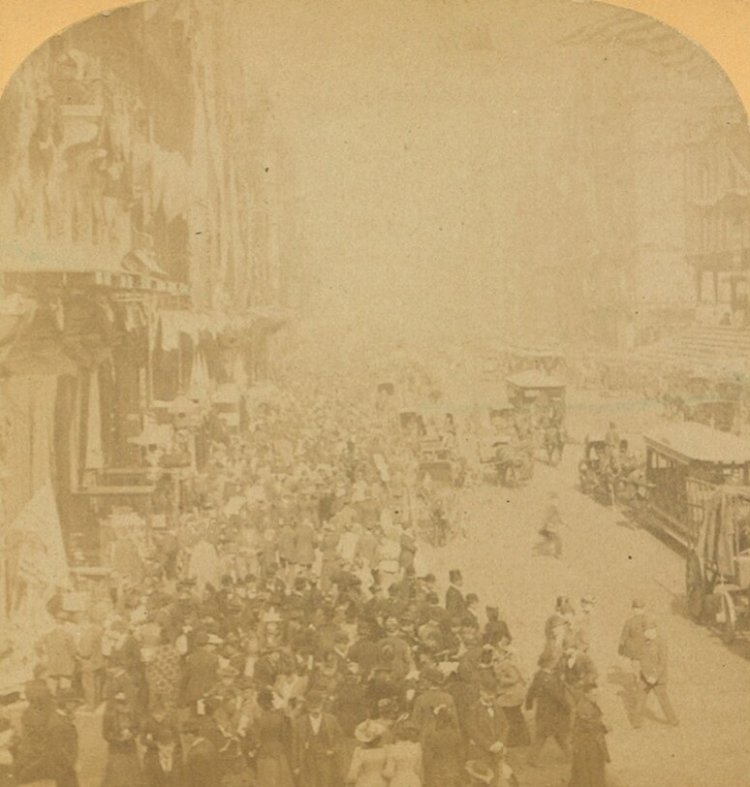
Strohmeyer & Wyman, State Street from Madison, in the World’s Fair City (1893). Public domain.
“Queen” Louise
A report printed early in 1894 came from one of the leaders of this work. The mission Sabbath school had started three weeks earlier with twenty children. The next week there were twenty-two, then forty-five. The workers gathered children “found in squalor or fighting on the streets,” and kept them quiet “by telling them simple Bible stories, and singing gospel songs.”⁴
Then he told what happened when he went out with one of the nurses:
I started out with Sister Louise last Sunday morning to visit some of the subjects for the purpose of taking a few photographs to throw upon the screen in talking about this work and to interest people in it. I had no sooner turned the corner than a little girl shouted at the top of her voice, “O here is Sister Louise!” and ran and threw her arms about her and expressed the greatest delight at seeing her.⁴
Her cry brought others. Children came running from every direction, shouting her name, until there was such a crowd that he had to walk out into the middle of the street. Before they had gone a block there were more than fifty children around her. “I felt very small and insignificant beside ‘Queen’ Louise,” he admitted.⁴
He explained why they loved her so:
Sister Louise had been in their homes and nursed them when they were sick and given up to die, some of them; had nursed their mothers and cared for them, had shown them how to clean up their homes and make them brighter; had given them little picture cards and flowers, and had said kind words to them, and like their parents they were ready to go down on their knees to her.⁴
His conclusion was simple: “It is perfectly wonderful what power there is in the influence of medical missionary work.”⁴
A story that crossed the world
The account was printed in the Bible Echo in Australia in March 1894. The believers there were inspired by it. Two months later the North Fitzroy church in Melbourne organized its own Christian Help Bands to visit the sick and the needy.⁵
That same year Ellen White, then in Australia, wrote to her son of a fresh conviction: “in this very line of hospitality, I have been repeatedly shown that we can unite the people with us, and can have twofold influence over them.”⁶
The simplest work is the most powerful
The Chicago work later grew large and costly, and Ellen White warned against spending so much on big institutions in one city while mission fields went without. Yet the work she commended was the simple, personal ministry Sister Louise did: visiting the sick, helping the poor, and teaching families how to live.⁷ Of the medical missionary workers who were doing this neglected work, she wrote, “If the medical missionary workers will carry this line of effort into the churches everywhere, if they will work in the fear of God, they will find many doors opened before them, and angels will work with them.”⁸
Sister Louise shows why medical missionary work is the best way to take the gospel forward. She was not famous, she held no office, and we do not even know her full name. But she nursed the sick in their homes, cared for their mothers, cleaned and brightened their rooms, and spoke kind words. That opened the hearts of a whole neighborhood. When the Sabbath school began, the children came gladly and listened.
Every church has someone who could be a Sister Louise. The work needs no large building or budget. It needs a person who will visit the sick, help a struggling mother, bring something bright to a dark home, and tell a child about Jesus. Heaven keeps the full record of such workers, even when history keeps only a first name.
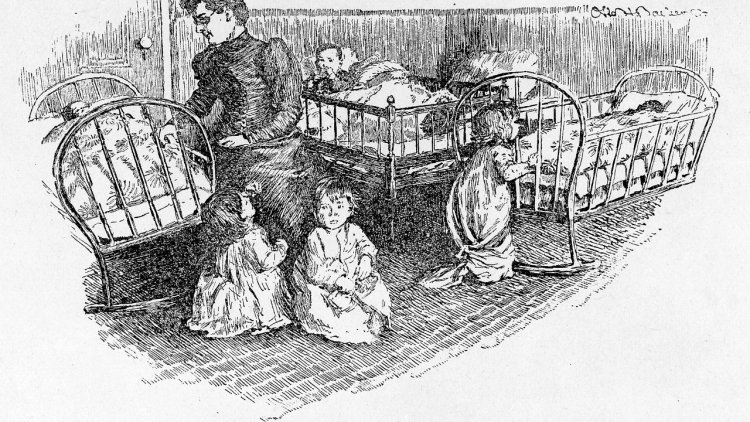
Cover picture: Unknown artist, Hull House Crèche, or Day Nursery, Chicago, from The Poor in Great Cities (1895). Wellcome Collection, CC BY 4.0.
Notes
- 1897 Year Book of the International Medical Missionary and Benevolent Association, 61, quoted in Dave Fiedler, d’Sozo: Reversing the Worst Evil, 2nd ed. (Adventist City Missions, 2012), 55–56.
- Dave Fiedler, Tactics: The Full Dossier (Remnant Publications, 2019), 112.
- Fiedler, d’Sozo, 59–60; The Life Boat (Chicago), November 1900, describing the Workingmen’s Home as “the outgrowth of the little medical mission and free dispensary started on Custom House place in 1893.”
- Bible Echo, March 18, 1894, quoted in Fiedler, d’Sozo, 133–134.
- Bible Echo, May 28, 1894, quoted in Fiedler, d’Sozo, 134.
- Ellen G. White to W. C. White, August 6, 1894, quoted in Fiedler, d’Sozo, 133.
- Fiedler, d’Sozo, 126–128.
- Ellen G. White, Testimonies for the Church, vol. 8, 70–72, quoted in Fiedler, d’Sozo, 124, and Fiedler, Tactics, 113.
Bibliography
Bible Echo, March 18, 1894; May 28, 1894.
Fiedler, Dave. d’Sozo: Reversing the Worst Evil. 2nd ed. Adventist City Missions, 2012.
Fiedler, Dave. Tactics: The Full Dossier. Remnant Publications, 2019.
The Life Boat (Chicago), November 1900.
1897 Year Book of the International Medical Missionary and Benevolent Association.
White, Ellen G. Testimonies for the Church, vol. 8. Pacific Press, 1904.
Take it further
Did this speak to you? Ask for more, or ask us to pray with you.
What's Your Reaction?
Comments 0
No comments yet. Be the first to share a thought.