God's Physician: Dr. John Harvey Kellogg
Gospel in Action
After the 1888 General Conference, a famous surgeon became a converted man, and his faith went to work. Through him the church learned what medical missionary work could do, and his later story warns what happens when it is cut off from the gospel.
Faith that works
The Bible does not separate faith from works of love. Paul speaks of “faith which worketh by love” (Gal. 5:6). James puts it plainly: “Shew me thy faith without thy works, and I will shew thee my faith by my works” (James 2:18). Jesus Himself “went about doing good, and healing all that were oppressed of the devil; for God was with him” (Acts 10:38).
Dr. John Harvey Kellogg, medical director of the Battle Creek Sanitarium, is probably the most gifted medical missionary worker the Seventh-day Adventist Church has had. His story shows how far faith that works by love can reach, and also how much is lost when a worker stops walking humbly with God.
A converted man
By 1888 Kellogg was already a leading figure in the church. He had directed the sanitarium for twelve years, and no one in the church had more education than he did.¹ Then came the General Conference at Minneapolis, where A. T. Jones and E. J. Waggoner preached righteousness by faith. Fifteen years later Ellen White remembered the change it made in him: “After the meeting at Minneapolis, Dr. Kellogg was a converted man, and we all knew it. We could see the converting power of God working in his heart and life.”²
What did people see? Ellen White describes the fruit of such a conversion: “Where faith is, good works appear. The sick are visited, the poor are cared for.”³
A visit to New York deepened his faith. Kellogg later said, “I never had much faith in God until I went down to the Jerry McAuley Mission in New York City, and saw how the Lord could save drunkards.”⁴
Faith goes to work
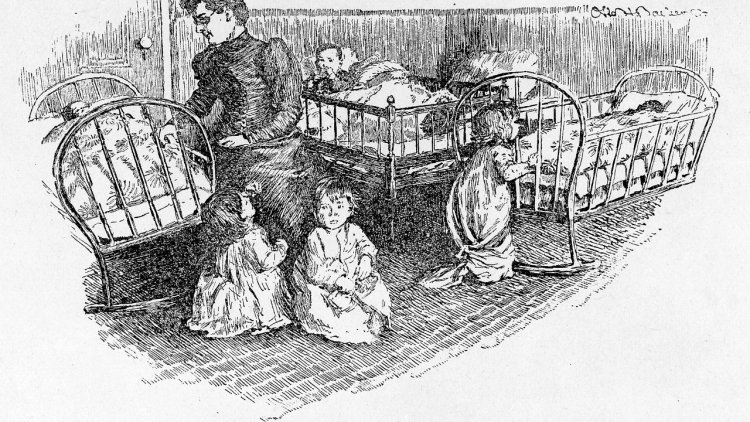
Orphans. In 1890 Kellogg spoke with Ellen White about a home for orphans. At the 1891 General Conference he showed that the Review had reported 774 Adventist children orphaned in five years, while church leaders could account for only 222.⁵ Donations came in slowly. Then in April 1892 a woman Kellogg had never met, Mrs. Caroline Haskell, walked into his office and offered to put up the whole building, at a cost of $30,000, in memory of her husband. She was not an Adventist.⁶ The Haskell Home was dedicated in January 1894.
Nurses for the poor. After a Chicago banker’s daughter died, he paid for a sanitarium nurse to work among the poor of the city. From that beginning Adventist nurses went into Chicago’s worst districts, and in 1893 the Chicago Medical Mission was born.⁷
Christian Help Bands. On November 15, 1892, Kellogg met with sanitarium workers to start organized Christian Help work. The first band had nine members: a leader, a gospel worker, a missionary nurse, three young men to carry burdens, and three young women to help mothers. They split wood for lonely widows, found boarders for a struggling widow, and brought food and clothing. Within months there were sixteen bands at the sanitarium, and the idea spread to Ann Arbor and, before long, to Australia.⁸
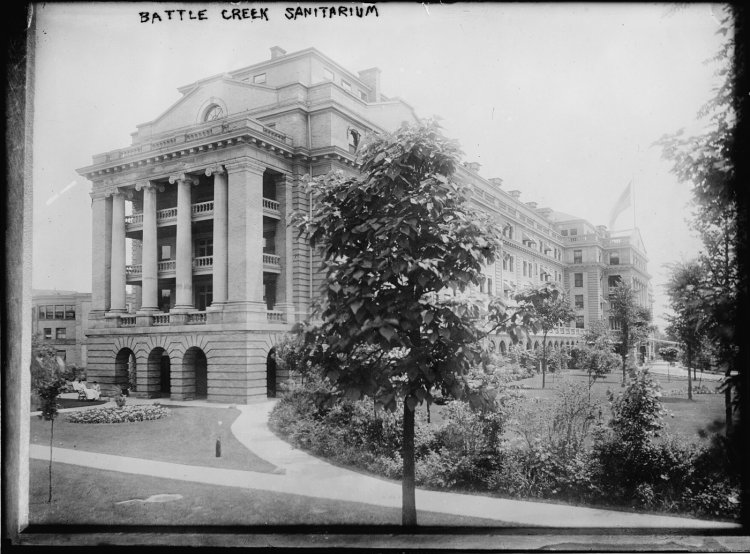
Bain News Service, Battle Creek Sanitarium (c. 1910). Public domain.
Doors that opened
Kellogg’s skill opened doors that were closed to the church. Ellen White wrote that his high standing in the medical profession “has an influence to remove from a large class the false impressions which have prevailed with regard to Seventh-day Adventists’ being an ignorant class of people.”⁹ In 1899 she said that through the sanitarium under his management “the truths of the third angel’s message have entered where it would otherwise have been very difficult for them to find entrance.”¹⁰
She also saw God’s hand in his surgery: “The Lord stood by the side of Dr. Kellogg as he performed difficult operations.”¹¹
Most of all, she saw that his workers were doing the work God had first offered to the whole church, which it had not taken up. She added a promise: “If the medical missionary workers will carry this line of effort into the churches everywhere, if they will work in the fear of God, they will find many doors opened before them, and angels will work with them.”¹²
Opposition and imbalance
Kellogg did not have an easy road. Many ministers resisted health reform, and some criticized him without knowing his work. Ellen White rebuked them sharply. To the General Conference president she wrote in 1888, “Dr. Kellogg is a finite man and has his errors as well as other men, but God has done a work through him and has been giving him strength.”¹³ In 1903 she told the General Conference that those who fought against him had a bad influence on him: “He put on the coat of irritation and retaliation.”¹⁴
Hurt by that opposition, Kellogg began to belittle the ministry and to place medical work above it. About 1896 his attitude toward the ministers and toward Ellen White began to change.¹⁵ He poured large sums into his work in Chicago while mission fields such as Australia went without, and he increasingly ignored her counsel.¹⁶ In 1900 she wrote, “The Lord has signified that the missionary, health-restorative gospel shall never be separated from the ministry of the word.”¹⁷
A man the church lost
In 1902 Kellogg’s book The Living Temple brought his pantheistic ideas into the open. Even then Ellen White worked to save him. In 1904 she wrote, “There is a work that Dr. Kellogg is educated to perform as no other man in our ranks can perform it; and if he will draw nigh to God, God will draw nigh to him.”¹⁸ It was not to be. In 1907 his name was removed from the membership of the Battle Creek Tabernacle church.¹⁹
This is the sad side of a great story, and it is told here because it carries a lesson. Paul warns, “Wherefore let him that thinketh he standeth take heed lest he fall” (1 Cor. 10:12). Kellogg’s gifts did not keep him. A walk with Christ would have. And the opposition of his brethren did not excuse his choices, though Ellen White held them partly responsible too.
What his life teaches
Kellogg’s best years show why medical missionary work is the best way to carry the gospel forward. An orphanage built by a stranger, nurses loved in the slums, help bands that put ordinary members to work, and a sanitarium that won respect for the truth: all of this came from a faith that worked by love.
His later years show the other half of the lesson. Medical work must never be separated from the gospel ministry, and those who lead it must stay humble before God. Ellen White put it this way: “When the gospel ministers and the medical missionary workers are not united, there is placed on our churches the worst evil that can be placed there.”²⁰
The work Kellogg began still belongs to the whole church. Every member can visit the sick, help the poor and teach the laws of health, and every minister can join that work to the preaching of the Word. When both are joined in Christ, the doors will open, and angels will work with us.
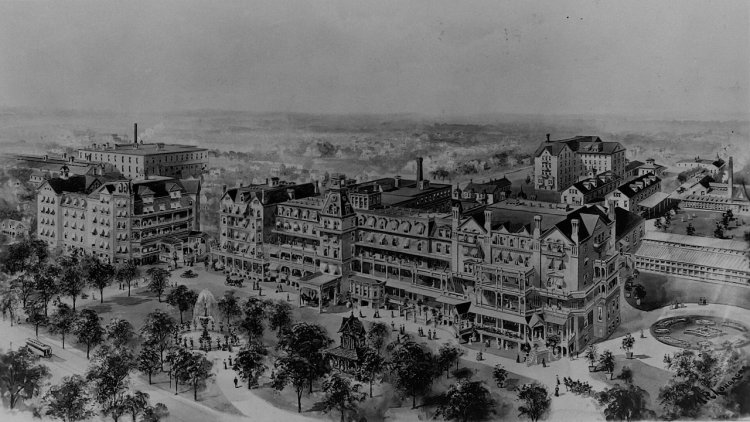
Cover picture: Gage Printing Co., Battle Creek Sanitarium before the Fire of 1902 (1908). Public domain.
Notes
- Dave Fiedler, d’Sozo: Reversing the Worst Evil, 2nd ed. (Adventist City Missions, 2012), 48.
- Ellen G. White, General Conference Bulletin, 1903, 86, quoted in Fiedler, d’Sozo, 48, and Dave Fiedler, Tactics: The Full Dossier (Remnant Publications, 2019), 111.
- Ellen G. White, Selected Messages, book 1, 398.
- J. H. Kellogg, General Conference Bulletin, 1897, 292, quoted in Fiedler, d’Sozo, 55.
- Ellen G. White, Testimonies for the Church, vol. 8, 133; General Conference Daily Bulletin, 1891; Fiedler, d’Sozo, 49–50.
- 1897 Year Book of the International Medical Missionary and Benevolent Association, 94–95, quoted in Fiedler, d’Sozo, 54–55; Fiedler, Tactics, 112.
- Fiedler, d’Sozo, 55–56, 59–60; Fiedler, Tactics, 112.
- The Medical Missionary, March/April 1893, 74–76, quoted in Fiedler, d’Sozo, 56–58.
- Ellen G. White to G. I. Butler, Letter 21, 1888, quoted in Fiedler, Tactics, 117.
- Ellen G. White, Letter 38, 1899, egwwritings.org.
- Ellen G. White, General Conference Bulletin, April 6, 1903, quoted in Fiedler, d’Sozo, 129.
- Ellen G. White, Testimonies for the Church, vol. 8, 70–72, quoted in Fiedler, d’Sozo, 124, and Fiedler, Tactics, 113.
- Letter 21, 1888, quoted in Fiedler, Tactics, 117.
- General Conference Bulletin, April 6, 1903, quoted in Fiedler, d’Sozo, 129.
- Manuscript Releases, vol. 4, 373, quoted in Fiedler, d’Sozo, 123, 125.
- Fiedler, d’Sozo, 125–128.
- Ellen G. White to G. A. Irwin, 1900, Manuscript Releases, vol. 4, 427, quoted in Fiedler, d’Sozo, 128.
- Ellen G. White, Special Testimonies, Series B, No. 2, 30, quoted in Fiedler, d’Sozo, 129–130.
- Fiedler, d’Sozo, 130.
- Ellen G. White, Loma Linda Messages, 59, quoted in Fiedler, d’Sozo, 225.
Bibliography
Fiedler, Dave. d’Sozo: Reversing the Worst Evil. 2nd ed. Adventist City Missions, 2012.
Fiedler, Dave. Tactics: The Full Dossier. Remnant Publications, 2019.
General Conference Bulletin, 1897; 1903.
The Medical Missionary, March/April 1893.
White, Ellen G. Letter 21, 1888; Letter 38, 1899.
White, Ellen G. Selected Messages, book 1.
White, Ellen G. Special Testimonies, Series B, No. 2.
White, Ellen G. Testimonies for the Church, vol. 8. Pacific Press, 1904.
Take it further
Did this speak to you? Ask for more, or ask us to pray with you.
What's Your Reaction?
Comments 0
No comments yet. Be the first to share a thought.