The Seven Trumpets: The Mystery of God Finished
Mystery Finished · Part 3 of 3
The seven churches ended with Christ at the door, and the seven seals ended with a sealed people able to stand. The seven trumpets carry the same story through the storms of history to its last word: a people in whom the mystery of God is finished.
“But in the days of the voice of the seventh angel, when he shall begin to sound, the mystery of God should be finished, as he hath declared to his servants the prophets.” (Revelation 10:7)
The third and final seven
In Part 1 we saw that Revelation is built on three great series of seven: churches, seals and trumpets. Each one opens with a scene in the heavenly sanctuary, and each one moves toward the same goal, a people in whom Christ fully lives. The churches showed Christ knocking at the door of Laodicea (Revelation 3:20). The seals asked, “Who shall be able to stand?” (Revelation 6:17), and answered with the sealing of God’s servants (Revelation 7:3). The trumpets now close the series by telling us what God will have accomplished when the last trumpet sounds.
Trumpets in Israel were never background music. They called the people to assemble, sounded the alarm of war, and opened the seventh month that led to the Day of Atonement (Numbers 10:1–10; Leviticus 23:24, 27). In Revelation they are warnings sent into history while the door of mercy is still open. Every blast says the same thing: judgment is real, time is short, and God is calling.
The seven trumpets at a glance
As with the churches and the seals, a simple outline helps us see the whole before we look at the parts. The dates follow the historicist reading of the Adventist pioneers.1
| Trumpet | Symbol | Power or event | Period (approx.) |
|---|---|---|---|
| First | Hail and fire mingled with blood | Visigoths under Alaric | 395–410 |
| Second | Burning mountain cast into the sea | Vandals under Genseric | 428–477 |
| Third | Great star falling on rivers | Huns under Attila | c. 434–453 |
| Fourth | Sun, moon and stars darkened | Odoacer; emperors and consuls fall | 476–541 |
| Fifth (first woe) | Locusts from the bottomless pit | Saracens, then the Ottomans; five months | From 632; July 27, 1299–1449 |
| Sixth (second woe) | Four angels loosed from the Euphrates | Ottoman Turks | 1449–August 11, 1840 |
| Interlude | Little book open; temple measured | Advent awakening and disappointment | 1840–1844 |
| Seventh (third woe) | Ark of His testament seen | Judgment; the mystery of God finished | 1844 to the Second Coming |
Incense before the storm
The trumpets begin, not on earth, but at the golden altar of incense in the holy place of the heavenly sanctuary.
“And another angel came and stood at the altar, having a golden censer; and there was given unto him much incense, that he should offer it with the prayers of all saints upon the golden altar which was before the throne. And the smoke of the incense, which came with the prayers of the saints, ascended up before God out of the angel’s hand. And the angel took the censer, and filled it with fire of the altar, and cast it into the earth: and there were voices, and thunderings, and lightnings, and an earthquake.” (Revelation 8:3–5)
Before a single trumpet sounds, we see intercession. The prayers of God’s people rise with the merit of Christ, pictured by the incense. Then the same censer is filled with fire and cast to the earth. The judgments that follow are God’s answer to the cries of His persecuted saints (compare Revelation 6:10), but they come from the altar of mercy. Even in judgment, heaven is pleading with men to repent.
Notice also how the trumpets are limited. They strike “the third part” again and again (Revelation 8:7–12). These are not yet the final plagues. They are partial judgments, warnings with mercy mixed in, given while Christ still ministers for sinners.
Four trumpets over Rome
The historicist reading held by Adventist pioneers sees the first four trumpets falling on the Western Roman Empire, the power that had crucified Christ and persecuted His church, as it broke apart under the invasions of the fifth century. A. T. Jones summed up the whole series simply: the first four trumpets bring the fall of the Western Empire of Rome, the fifth and sixth the fall of the Eastern Empire, and the seventh the fall of all nations and of the world itself. He also noticed something that makes these old judgments very current. The peoples God used to bring down Western Rome became, in their descendants, the great nations of Western Europe today, still living subjects of the prophecies for our time.1
The first trumpet: hail and fire
“The first angel sounded, and there followed hail and fire mingled with blood, and they were cast upon the earth: and the third part of trees was burnt up, and all green grass was burnt up.” (Revelation 8:7)
Like a hailstorm from the north, the Visigoths under Alaric swept through the empire from A.D. 395. They burned and plundered across Greece and Italy, and in 410 Rome itself, the eternal city, was sacked for the first time in eight hundred years.2
The second trumpet: a burning mountain in the sea
“And the second angel sounded, and as it were a great mountain burning with fire was cast into the sea: and the third part of the sea became blood.” (Revelation 8:8)
The second blow came by sea. From 428 Genseric and the Vandals took North Africa, built a fleet at Carthage, and ruled the Mediterranean. Roman fleets sent against them were destroyed, and in 455 the Vandals plundered Rome for fourteen days. Among the spoils carried off to Carthage were the gold table and the seven-branched candlestick taken from the temple at Jerusalem four centuries earlier.3
The third trumpet: a falling star
“And the third angel sounded, and there fell a great star from heaven, burning as it were a lamp, and it fell upon the third part of the rivers, and upon the fountains of waters.” (Revelation 8:10)
Attila and the Huns blazed across the empire like a meteor. He called himself “the scourge of God.” His campaigns ran along the river valleys of the Danube, the Rhine and the Po, where the empire’s waters had their sources. Then, suddenly as he had risen, he died in 453, and his power vanished.4
The fourth trumpet: the lights go out
“And the fourth angel sounded, and the third part of the sun was smitten, and the third part of the moon, and the third part of the stars; so as the third part of them was darkened, and the day shone not for a third part of it, and the night likewise.” (Revelation 8:12)
In 476 Odoacer, chief of the Heruli, deposed Romulus Augustulus, the last emperor of the West. The sun of the empire had set, though the lesser lights shone faintly for a while, until Justinian extinguished the Roman consulship in 541. To people who did not know the word of God, Jones observes, the fall of an empire that had seemed to be the whole civilized world felt like the end of the world itself.5
Then an eagle flies through heaven with a solemn cry: “Woe, woe, woe, to the inhabiters of the earth by reason of the other voices of the trumpet of the three angels, which are yet to sound!” (Revelation 8:13). The last three trumpets are heavier still.
Two woes from the east
The fifth trumpet: locusts from the pit
The fifth trumpet brings a cloud of locusts out of the smoke of the bottomless pit (Revelation 9:1–3). The pioneers applied the fifth and sixth trumpets to the rise of Islam. The armies of Muhammad’s successors poured out of Arabia, the land of the locust, and swept across Persia, Syria, Egypt and North Africa. Later the Ottoman Turks carried the same faith and banner into the heart of the Eastern Empire. Under these two woes God allowed Islamic power to be a scourge on a Christendom that had exchanged the gospel for images, relics and the worship of saints. The two eastern woes fell on the eastern half of the empire, as the first four had fallen on the west.6 One detail deserves our attention:
“And it was commanded them that they should not hurt the grass of the earth, neither any green thing, neither any tree; but only those men which have not the seal of God in their foreheads.” (Revelation 9:4)
Here the trumpets reach back to the seals. The seal of God marks a people God protects. History is never out of His hands; even its storms are measured. The locusts were to torment “five months” (Revelation 9:5, 10), which on the year-day principle (Numbers 14:34; Ezekiel 4:6) is 150 years. The prophecy says the locusts “had a king over them” (Revelation 9:11). The scattered Saracen raids had no single ruler, but in time the Turks were gathered under Othman, founder of the Ottoman dynasty. Josiah Litch and the Millerite expositors counted the five months from July 27, 1299, when Othman first invaded the territory of Nicomedia, to 1449.7
The sixth trumpet: the hour, day, month and year
“And the four angels were loosed, which were prepared for an hour, and a day, and a month, and a year, for to slay the third part of men.” (Revelation 9:15)
A. T. Jones explains the loosing of the four angels as “the letting loose of all the elements of Mohammedanism for the final sweeping away of the last element of the Empire of Rome.” In 1453 Constantinople fell to the Ottomans, and the Eastern Empire was no more.
The time of this trumpet began where the fifth ended, July 27, 1449. Counting thirty days to a month and a day for a year, a year is 360 years, a month 30 and a day 1, making 391 years; the hour, a twenty-fourth of a year, adds 15 days. From July 27, 1449, that reaches August 11, 1840.
In 1838 Litch published his expectation that Ottoman independence would be broken in 1840, and on August 1, 1840, he named the very day, August 11. On that day the ultimatum of the four great powers, England, Russia, Austria and Prussia, was delivered to Mehemet Ali, and the actual power of the Turkish government passed into their hands. From then on Turkey stood only by their consent.8 Ellen G. White recorded the result: “In the year 1840 another remarkable fulfillment of prophecy excited widespread interest.” She notes that the prediction was widely published and watched by thousands, and that its fulfilment gave a great impetus to the advent movement.9
Yet the sixth trumpet ends on a sad note:
“And the rest of the men which were not killed by these plagues yet repented not of the works of their hands.” (Revelation 9:20)
Judgment alone does not change hearts. Six trumpets had sounded across fourteen centuries, and men still clung to their idols and their sins. Something more than judgment was needed. That is what the interlude between the sixth and seventh trumpets reveals.
A word is in order here, because Sozo is read across the Muslim world. These trumpets describe what God permitted powers to do in history, not His heart toward any people. The same Revelation sees a great multitude “of all nations, and kindreds, and people, and tongues” before the throne (Revelation 7:9). Christ died for the descendants of Ishmael as surely as for the descendants of Isaac, and the last message is for them too.
The little book and the bitter disappointment
Just as the seals paused between the sixth and seventh to show the sealing (Revelation 7), the trumpets pause to show a message. A mighty angel comes down from heaven, clothed with a cloud and crowned with a rainbow, with a little book open in his hand. He sets one foot on the sea and one on the land and swears “that there should be time no longer” (Revelation 10:1–6).
Daniel had been told to “shut up the words, and seal the book, even to the time of the end” (Daniel 12:4). Now the book is open. The time prophecies of Daniel, above all the 2,300 days of Daniel 8:14, were unsealed and preached across the world in the great advent awakening. When the angel swears that there shall be time no longer, he marks the end of the prophetic time periods. No prophetic date points beyond 1844.10
“And I took the little book out of the angel’s hand, and ate it up; and it was in my mouth sweet as honey: and as soon as I had eaten it, my belly was bitter.” (Revelation 10:10)
This is the experience of the Advent believers. The message that Jesus was coming was sweet as honey. Then came October 22, 1844, and the bitter disappointment. But the angel did not leave them in their tears:
“And he said unto me, Thou must prophesy again before many peoples, and nations, and tongues, and kings.” (Revelation 10:11)
Out of the disappointment came a worldwide movement and a fuller message. John is then told to “measure the temple of God, and the altar, and them that worship therein” (Revelation 11:1). Heaven was not done. Christ had entered the most holy place to begin the investigative judgment, and a people was to be raised up to proclaim the three angels’ messages of Revelation 14 to every nation. That movement is still sounding today.
The seventh trumpet: the ark is seen
“And the seventh angel sounded; and there were great voices in heaven, saying, The kingdoms of this world are become the kingdoms of our Lord, and of his Christ; and he shall reign for ever and ever.” (Revelation 11:15)
The seventh trumpet covers the closing work of Christ and the setting up of His kingdom. The elders announce “the time of the dead, that they should be judged” (Revelation 11:18). The same verse opens with the words, “And the nations were angry.” Jones observed that the third woe was to come “quickly” after the second (Revelation 11:14), and that from a little after 1840 the temper of the nations has matched that description exactly.11 Then comes the sanctuary scene that crowns the whole series:
“And the temple of God was opened in heaven, and there was seen in his temple the ark of his testament: and there were lightnings, and voices, and thunderings, and an earthquake, and great hail.” (Revelation 11:19)
The ark stood only in the most holy place, so this is the Day of Atonement scene. Inside the ark were the Ten Commandments, written by the finger of God (Exodus 25:16; 31:18). When the seventh trumpet sounds, the eyes of God’s people are directed into the most holy place, and there they see the law of God, with the Sabbath at its heart. It is no accident that the remnant of Revelation 12 and 14 is described as those who “keep the commandments of God” (Revelation 12:17; 14:12).
Why would the law be at the center of the last scene? Because the law has been at the center of the great controversy from the beginning.
Satan’s charge against the law
Satan’s quarrel was never only with man. It was with God’s government. He claimed that God’s law was unjust and could not be kept, and that a God who demanded obedience from His creatures was a tyrant. Scripture shows us his method in the garden: “Yea, hath God said?” (Genesis 3:1). Ellen G. White confirms it:
“Satan represents God’s law of love as a law of selfishness. He declares that it is impossible for us to obey its precepts.” (The Desire of Ages, p. 24 / DA 24)12
“In the opening of the great controversy, Satan had declared that the law of God could not be obeyed, that justice was inconsistent with mercy, and that, should the law be broken, it would be impossible for the sinner to be pardoned.” (The Desire of Ages, p. 761 / DA 761)13
God did not answer that charge with force. He answered it with His Son. Christ came “in the likeness of sinful flesh” and “condemned sin in the flesh: That the righteousness of the law might be fulfilled in us, who walk not after the flesh, but after the Spirit” (Romans 8:3, 4). His life of perfect obedience as a man exposed the lie. Ellen G. White writes that His life “testifies that it is possible for us also to obey the law of God.”14
But notice Paul’s words: “fulfilled in us.” The cross secured the victory, and Christ’s life proved the charge false in one Man. The question the universe still waits to see answered is whether that same life can be reproduced in a people living in sinful flesh, in the last and darkest hour of earth’s history. This is where the seventh trumpet leads.
The mystery finished
Revelation 10:7 says that under the seventh trumpet “the mystery of God should be finished.” Scripture tells us exactly what that mystery is:
“Even the mystery which hath been hid from ages and from generations, but now is made manifest to his saints: To whom God would make known what is the riches of the glory of this mystery among the Gentiles; which is Christ in you, the hope of glory.” (Colossians 1:26, 27)
Paul shows what this looks like in a single life:
“I am crucified with Christ: nevertheless I live; yet not I, but Christ liveth in me: and the life which I now live in the flesh I live by the faith of the Son of God, who loved me, and gave himself for me.” (Galatians 2:20)
Paul calls it “the mystery of godliness: God was manifest in the flesh” (1 Timothy 3:16). The mystery began in Bethlehem, when God was manifest in the flesh of His Son. It is finished when God is manifest in the flesh of His people. The mystery is not finished when the last sermon is preached or the last book is sold. It is finished when Christ in you is no longer a hope only but a full reality in a people ready for His coming.
“Christ is waiting with longing desire for the manifestation of Himself in His church. When the character of Christ shall be perfectly reproduced in His people, then He will come to claim them as His own.” (Christ’s Object Lessons, p. 69 / COL 69)15
This is the final generation. John sees them standing with the Lamb on mount Sion, and says of them: “in their mouth was found no guile: for they are without fault before the throne of God” (Revelation 14:5). They are the answer to Satan’s charge. In them the universe sees that the law can be kept, not by human strength, but by Christ living His life within.
“The very image of God is to be reproduced in humanity. The honor of God, the honor of Christ, is involved in the perfection of the character of His people.” (The Desire of Ages, p. 671 / DA 671)16
This people must stand when Christ’s intercession ends. Ellen G. White describes what that requires: those living when Christ’s intercession ceases “are to stand in the sight of a holy God without a mediator,” with robes spotless and characters “purified from sin by the blood of sprinkling.”17 That is not a burden laid on us to carry alone. It is a promise of what grace will do. “Jesus revealed no qualities, and exercised no powers, that men may not have through faith in Him.”18
Tried, but not overcome
What does it mean in practice for the mystery to be finished in a people? John gives the plain definition of sin: “sin is the transgression of the law” (1 John 3:4). The final generation are not people who are no longer tempted. They are people in whom Christ lives so fully that they no longer choose to break His law.
Paul explains how this happens:
“This I say then, Walk in the Spirit, and ye shall not fulfil the lust of the flesh. For the flesh lusteth against the Spirit, and the Spirit against the flesh: and these are contrary the one to the other: so that ye cannot do the things that ye would.” (Galatians 5:16, 17)
Notice that the flesh still lusts. The struggle is real, and the sinful nature is not removed until “this mortal must put on immortality” (1 Corinthians 15:53). But the one who walks in the Spirit does “not fulfil the lust of the flesh.” The pull is felt, but the sin is not committed. John says the same:
“Whosoever is born of God doth not commit sin; for his seed remaineth in him: and he cannot sin, because he is born of God.” (1 John 3:9)
This verse can sound heavy, but its weight rests on God, not on us. John does not say the believer cannot sin because he tries hard enough. He says it is because he is “born of God” and God’s “seed remaineth in him.” The life of God within is what breaks sin’s hold. In the same letter John writes “that ye sin not,” and in the same breath he adds, “if any man sin, we have an advocate with the Father, Jesus Christ the righteous” (1 John 2:1). Victory is the goal, and we walk toward it with an Advocate at our side.
Ellen G. White shows this victory under the hardest test of all. In the time of trouble, after probation has closed, Satan does everything he can against God’s people. He accuses them before God, presses on them the sins he once tempted them to commit, and tries to drive them to despair. Ellen G. White states his aim plainly: “He hopes so to destroy their faith that they will yield to his temptations and turn from their allegiance to God.”19 Yet they hold on:
“The season of distress and anguish before us will require a faith that can endure weariness, delay, and hunger—a faith that will not faint though severely tried.” (The Great Controversy, p. 621 / GC 621)20
Their faith is tried to the limit, but it does not let go, and they do not sin. The devil can press as hard as he likes, but he cannot make them yield. Their pattern is Christ, who said, “the prince of this world cometh, and hath nothing in me” (John 14:30). Satan found nothing in Christ that would give him the victory, and Ellen G. White draws the lesson: “This is the condition in which those must be found who shall stand in the time of trouble.”21
None of this calls for anxious self-watching. It is a promise of what Christ will do in those who keep looking to Him. “Not I, but Christ” is the secret of the last generation, as it has been for every believer.
One story in three sevens
Now the whole structure comes together.
- The seven churches end with Christ at the door: “If any man hear my voice, and open the door, I will come in to him” (Revelation 3:20). This is Christ entering the life.
- The seven seals end with the sealing of God’s servants in their foreheads (Revelation 7:3). This is Christ settling His character in the mind so firmly that it cannot be moved.
- The seven trumpets end with the mystery of God finished (Revelation 10:7). This is Christ fully revealed in a people, and the great controversy answered.
Christ let in, Christ’s character sealed, Christ fully revealed. The three sevens are not three unrelated puzzles about the past. They are one invitation to the last generation. The churches tell us who we are, Laodiceans who need everything. The seals tell us what we must become, a people able to stand. The trumpets tell us what God will do, finish His work in us and close the controversy forever.
“Being confident of this very thing, that he which hath begun a good work in you will perform it until the day of Jesus Christ.” (Philippians 1:6)
The trumpet is sounding now
We are living in the days of the seventh trumpet. The ark has been seen, the judgment is sitting, and the last message is going to every nation, tongue and people. The question is no longer whether God can finish His work. The question is whether we will let Him finish it in us.
The trumpets warned the world through fourteen centuries, and still “they repented not.” Let it not be said of us. The same Jesus who stood at the door of Laodicea and who seals His people in their foreheads is ready to complete what He has begun. He is “able to keep you from falling, and to present you faultless before the presence of his glory with exceeding joy” (Jude 24).
Lord Jesus, You have knocked, and I open the door. Seal Your character in my mind, and finish Your work in me. Where Satan says Your law cannot be kept, let my life say that Your grace is greater. Make me part of the people in whom the mystery of God is finished, and come quickly. Amen.
The trumpet does not ask whether God can finish His work. It asks whether He may finish it in you.
“But in the days of the voice of the seventh angel, when he shall begin to sound, the mystery of God should be finished, as he hath declared to his servants the prophets.” (Revelation 10:7)
Coming next: Are the 144,000 and the great multitude of Revelation 7 the same group?

Belden Orina holds a BSc and an MSc in Computer Science from Periyar University, India, and is completing a Bachelor of Theology at Bugema University. He has a keen interest in health evangelism, lifestyle coaching and evangelistic ministry, and writes on the gospel that saves the soul and heals the body.
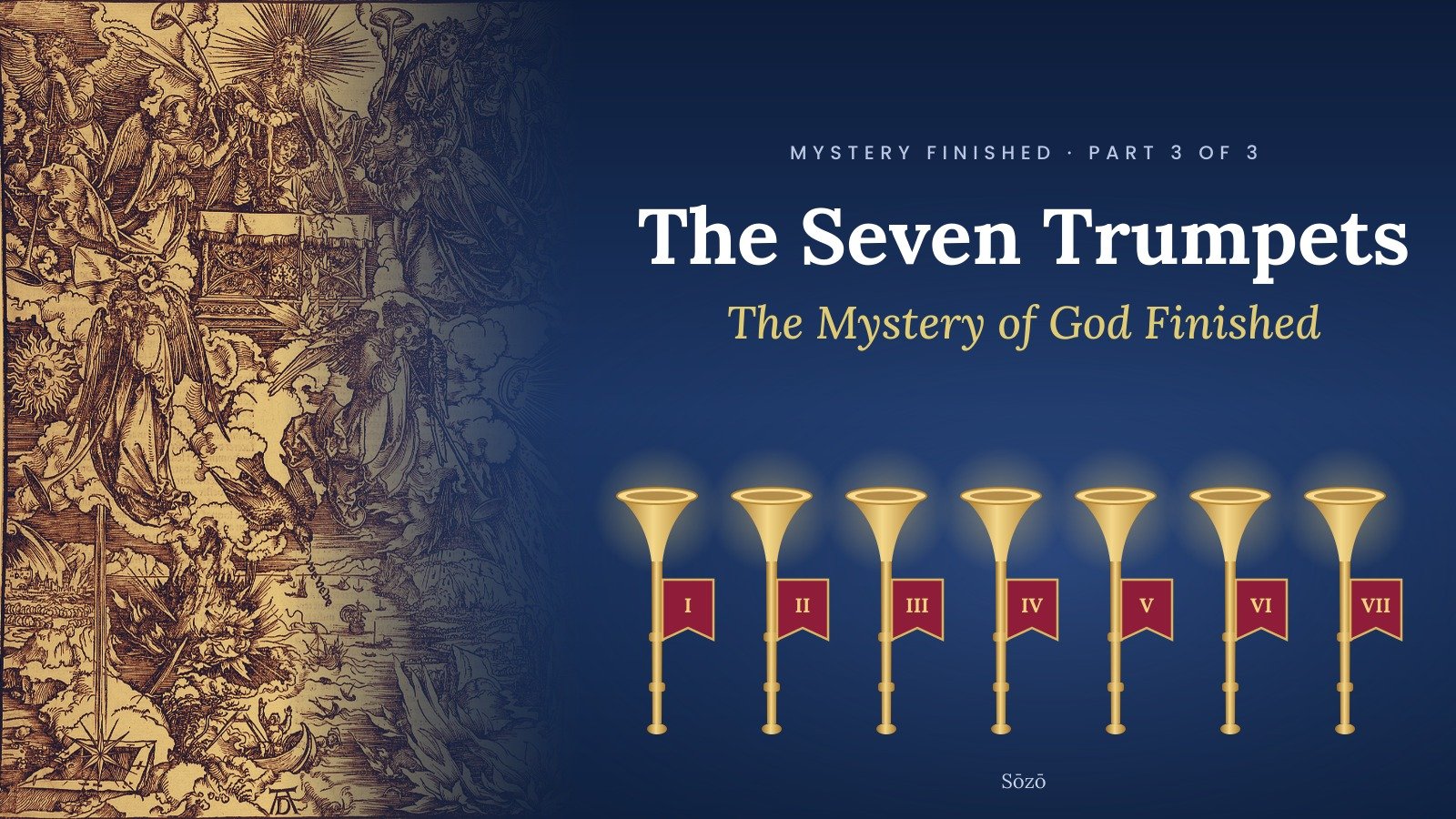
Cover: Albrecht Dürer, The Seven Angels with the Trumpets (c. 1496–98), from The Apocalypse. Public domain.
Notes
Scripture quotations are from the King James Version.
- A. T. Jones, The Eastern Question (1896), 1–2; A. T. Jones, The Great Nations of To-day (1901), quoted in Patrick M. Jones, comp., Gems from Revelation (2012), 202. See also Uriah Smith, Daniel and the Revelation (1897), 477–478.
- Jones, Great Nations of To-day, 15, in Gems from Revelation, 202–203; Edward Gibbon, The History of the Decline and Fall of the Roman Empire, chaps. 30–31. See also Smith, Daniel and the Revelation, 478–479.
- Jones, Great Nations of To-day, 17, in Gems from Revelation, 205; Gibbon, Decline and Fall, chaps. 33 and 36. See also Smith, Daniel and the Revelation, 480–481.
- Gibbon, Decline and Fall, chaps. 34–35. See also Smith, Daniel and the Revelation, 484–487.
- Gibbon, Decline and Fall, chaps. 36 and 40; Jones, Great Nations of To-day, 7, in Gems from Revelation, 210. See also Smith, Daniel and the Revelation, 487–490.
- Jones, Great Nations of To-day, chap. 8; Gems from Revelation, 218. See also Smith, Daniel and the Revelation, 495–506.
- Jones, Great Nations of To-day, 40, in Gems from Revelation, 222; J. N. Loughborough, The Great Second Advent Movement (1905), 129. See also Smith, Daniel and the Revelation, 507.
- Jones, Great Nations of To-day, 72–77; Josiah Litch, Signs of the Times, and Expositor of Prophecy, August 1, 1840; Loughborough, Great Second Advent Movement, 129; Gems from Revelation, 227, 229. See also Smith, Daniel and the Revelation, 508–516.
- Ellen G. White, The Great Controversy (1911), 334–335 (GC 334–335).
- Gems from Revelation, 231–237. See also Smith, Daniel and the Revelation, 518–525.
- Jones, Great Nations of To-day, 85.
- Ellen G. White, The Desire of Ages (1898), 24.
- White, The Desire of Ages, 761.
- White, The Desire of Ages, 24.
- Ellen G. White, Christ’s Object Lessons (1900), 69.
- White, The Desire of Ages, 671.
- White, The Great Controversy, 425.
- White, The Desire of Ages, 664.
- White, The Great Controversy, 618–619.
- White, The Great Controversy, 621.
- White, The Great Controversy, 623.
Take it further
Did this speak to you? Ask for more, or ask us to pray with you.
What's Your Reaction?
Comments 0
No comments yet. Be the first to share a thought.