Three Crosses on a Hill: The Everlasting Gospel of Jesus
Faith & Salvation · The cross
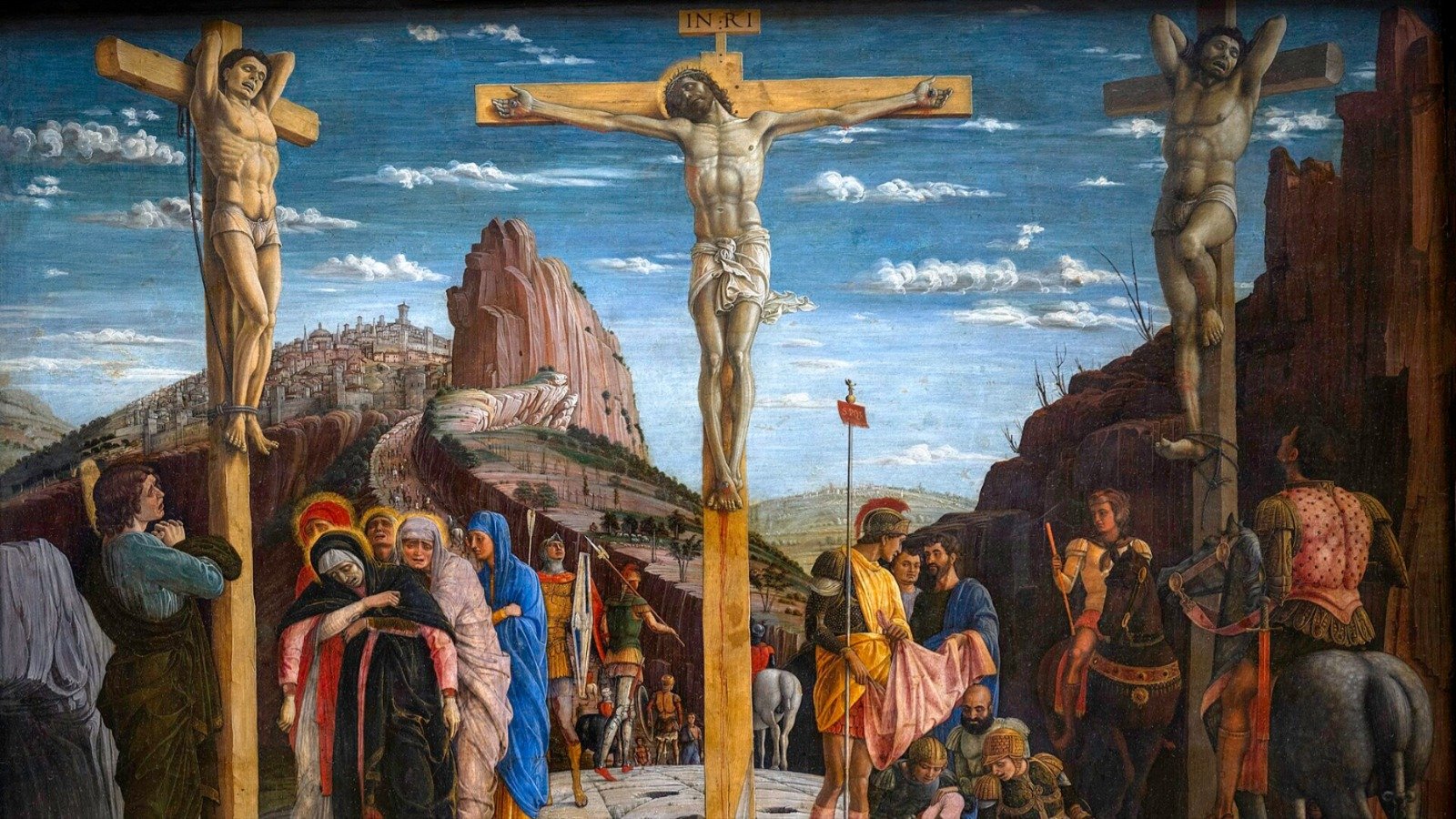
Three crosses stood on a hill outside old Jerusalem. On the middle one hung the Son of God; on either side hung a thief. In those three men the whole gospel story is told, and every one of us is represented there.
“And when they were come to the place, which is called Calvary, there they crucified him, and the malefactors, one on the right hand, and the other on the left.” (Luke 23:33)
The midnight of the world
I am happy to stand before you and give an answer for the faith that is within me. I want to point us to the three crosses on that hill outside old Jerusalem, for Jesus’ last interview was with a man on a cross.
Our Lord came into this world at the midnight of the world. The world He was born into was one of stark terror, where life was often not worth living. The message of the philosophers had been found wanting. Slavery, violence and lust ruled the day. The Roman legions were ruthless, and mad emperors held absolute power over everyone they ruled. Under Roman law, if a slave dared to attempt the life of a cruel master, every slave in that household could be put to death. Hundreds could die for the act of one. That was the world our Saviour was born into, in the providence of God.
Then came Jesus, at the midnight of the world. And we heard such things as these:
“For God so loved the world, that he gave his only begotten Son, that whosoever believeth in him should not perish, but have everlasting life.” (John 3:16)
“I am come that they might have life, and that they might have it more abundantly.” (John 10:10)
“Peace I leave with you, my peace I give unto you: not as the world giveth, give I unto you. Let not your heart be troubled, neither let it be afraid.” (John 14:27)
“Behold, I give unto you power to tread on serpents and scorpions, and over all the power of the enemy: and nothing shall by any means hurt you.” (Luke 10:19)
His message changed the world forever. Jesus taught that God His Father was like a daddy. In the language of that day it was “Abba, Father” (Mark 14:36). He is a Father who attends the funeral of every fallen sparrow and who knows the number of the hairs on our heads (Matthew 10:29, 30).
The midnight at midday
At the end of the Saviour’s life came the midnight at midday. From the sixth hour to the ninth hour there was darkness over all the land (Matthew 27:45). An old story tells of a galley of slaves rowing on the Adriatic Sea that afternoon. As they pulled on the oars, the sun suddenly disappeared at midday. These were pagan slaves, who believed the sun was their god. The darkness was so dense it seemed it could be felt, and out of the darkness one of the slaves cried, “The great Sun God is dead!”
The centre of that darkness was Jerusalem, the centre of the world that Friday afternoon. In those days anyone travelling to Egypt, or up toward Rome, had to pass through Palestine and Jerusalem. Jerusalem was the crossroads of the world.
Let us focus on the three crosses that stood on Golgotha’s hill, the place of a skull. All men and women were represented there: young and old, black and white, male and female, free and bond, the learned and the ignorant, the sacred and the secular. You and I were represented there that day. Scripture tells us that in the place where Jesus was crucified there was also a garden (John 19:41). It was the place of the skull, but it was also the place of a garden.
Life relentlessly brings sorrow as well as joy to each of us. Crosses are inevitable for all who are born on this earth. The only choice is which cross we will identify with. Will we stand with the man on the left, cursing God and blaming Him for our woes? Or will we stand with the man on the right, the man with whom Christ had His last interview? His cross was the prelude to a crown.
The man in the middle
So let us picture these men. Let us stand in that crowd, watch, and let what we see go deep into our hearts. Three men hang between earth and the heavens, between the earth and the stars.
In the centre was the One called Messiah, the Son of man, the Son of God, the Redeemer, Jehovah. This man in the centre is goodness itself. The hands nailed there were the same hands that stroked the hair of children on His lap. Those hands had broken the bread so that the hungry might eat on that grassy hillside. Those spiked feet were the same feet that travelled many miles to heal the daughter of a Gentile woman on the borders of Tyre and Sidon. The head crowned with thorns held the mind that spoke the Beatitudes on the mountainside, that explained the deeper meaning of the Ten Commandments Moses had given, and that promised the meek would inherit the earth and the merciful would obtain mercy. The side torn open by a spear covered a heart that loved all people, good and evil, black and white, rich and poor.
On Golgotha’s hill that day we find supreme goodness put to the most extreme pain. And the question comes: how can there be a God if the penalty for perfect goodness is extreme pain? How can that be? The cross is the supreme mystery.
The crowd had come out of the city full of joking, mockery and ridicule. But it would soon be reversed. When they realised they had put the Son of God to death, they went home beating their breasts (Luke 23:48). History stood still that day. The earth shook as it recognised its Creator. When He cried, “It is finished,” and bowed His head in death, the veil of the temple was torn from top to bottom, exposing the most holy place. God’s presence was no longer there. The rocks split, graves were opened, and many who had long been dead came out and went into the city and appeared to many (Matthew 27:51–53). Those who had witnessed that day and its midnight went home beating their breasts. What have we done? What have we done?
It was a miniature of the final day, when Jesus comes and the trumpet sounds. Then the graves will burst open, and those who have loved their Lord will come forth to eternal life.
Prophet, priest and king
Prophet. First of all, the Saviour was a prophet that day. On the way to the cross He spoke as a prophet to the women who followed Him: “Daughters of Jerusalem, weep not for me, but weep for yourselves, and for your children” (Luke 23:28). The time was coming when Jerusalem would be destroyed. And He added, “For if they do these things in a green tree, what shall be done in the dry?” (Luke 23:31). In other words, if they do this to Me, the Saviour, what will become of My people Israel?
Priest. Second, He is a priest. As soon as His blood began to flow, we see Him as a priest. “Then said Jesus, Father, forgive them; for they know not what they do” (Luke 23:34). When? When they crucified Him. As soon as the blood flowed, He was interceding for every man and woman ever born, including you and me. The cross was both an altar and a mercy seat sprinkled with His blood.
King. Third, the cross was a throne. That is why He still wore His crown, though it was a crown of thorns. Scripture tells us they took off the purple robe, but it says nothing about removing the crown of thorns. And Scripture says they crucified Him there, “and Jesus in the midst” (John 19:18). He is in the middle because He divides all people for all time into two groups: those who accept Him and His gospel, and those who do not. All of us are on one side or the other. That day we see the man in the middle as prophet, priest, and King on the throne of the cross. The judgment has come. The gospel separates all people.
The middle cry
He had hung there three hours. Then came the darkness. What did this darkness mean? There were seven cries from our Lord on the cross. The One against whom seven accusations were made, who went through seven trials, uttered seven cries. The cross was an altar and a mercy seat, a throne and a judgment bar, and a triumphant victory over Satan and all his hosts, though it did not look like it that day. The cross was also a pulpit, from which He spoke seven times.
The middle cry unlocks the mystery of the midday darkness and of the cross. It unlocks the mystery of pain and guilt, of life and death. Jesus cried out, “My God, my God, why hast thou forsaken me?” (Matthew 27:46). All the terrible pain of the flesh He could bear. But when He sensed that His Father had forsaken Him, His heart broke.
He had known the hostility of His countrymen, who tried to throw Him off a cliff at Nazareth (Luke 4:29). He had known the religious leaders, His own people, reject Him. He had seen the government officials refuse to protect Him. Then His followers forsook Him, and one of His own betrayed Him. He passed through all of that unshaken. Through it all He was still able to promise a place in the heavenly country to a man hanging on a cross beside Him.
Then something changed. His countrymen had rejected Him, the government that should have protected Him had failed Him, His followers had fled, and now even His God seemed to have rejected Him. He bowed His head and died.
There is no experience we go through that can equal what Jesus went through. Never. There is no wound of ours for which Christ has not provided a balm, no pain for which He has not provided an answer. The ultimate for the Saviour was to be forsaken by God Himself. For the first time in eternity, Jesus was separated from His Father, or so it seemed to Him. But God the Father was at the cross that day, hidden in the thick darkness. It had to be, so that you and I could be saved.
What the darkness means
Scripture invites us to look at this cross and ask why supreme goodness is put to ultimate pain. What does this darkness mean? The answer is really quite simple. Sin always brings separation. Sin brings abandonment. One day, when He comes in the clouds and the trumpet sounds, Jesus will finally say to some, “Depart from me, ye that work iniquity” (Matthew 7:23).
Christ was on the cross in your place and mine. He tasted the terrors of the second death. He endured the torment of the lost. This is the meaning of the cross and the meaning of the darkness. There is such a thing as right and wrong, my friend. “The wages of sin is death” (Romans 6:23). He was forsaken that day so that we might never be forsaken.
Romans 8 says it beautifully and clearly: “He that spared not his own Son, but delivered him up for us all, how shall he not with him also freely give us all things?” (Romans 8:32). There it is.
Galatians 3 says the same: “Christ hath redeemed us from the curse of the law, being made a curse for us” (Galatians 3:13). He was made to be sin for us (2 Corinthians 5:21). That is why Moses lifted up the serpent on a pole in the wilderness (Numbers 21:8, 9; John 3:14), a foretaste of what Jesus would do for us at the cross. He is the Son of God, “who loved me, and gave himself for me” (Galatians 2:20). Oh, wonder of wonders, how can it be?
Some of the greatest words in Scripture are these: “whosoever will, let him take the water of life freely” (Revelation 22:17). Whosoever will may come, hear the gospel and behold the Lamb of God, “which taketh away the sin of the world” (John 1:29). “While we were yet sinners, Christ died for us” (Romans 5:8).
The whole human race has been reconciled to God, but the whole human race does not know it yet. The barriers between God and man are down. We have access to the very throne of God. Our thoughts and prayers can rise to His throne because of what Jesus did for us. “God was in Christ, reconciling the world unto himself” (2 Corinthians 5:19). Yes, God the Father was there at the cross that day. He was in Jesus.
The last interview
Jesus’ last interview, recorded in Luke 23, speaks to every century, before the cross and after it, from the earth in the beginning to the earth made new, and on through eternity. “And one of the malefactors which were hanged railed on him, saying, If thou be Christ, save thyself and us” (Luke 23:39).
Matthew adds a little more. He tells us that at first both thieves taunted and reviled Him (Matthew 27:44). So the man on Jesus’ right, saved at the eleventh hour of his life, had been cursing Jesus just a short while before. Some have asked, God, do You really know what You are doing here? But what a wonderful encouragement this is for us. Some of us feel our sins are so many, and so recent, that there is no hope for us. This man was cursing Christ only a little while before he was promised the heavenly country. Think of that. God takes a thief, a man who cursed Him right up to the last moments of his life, and gives him heaven. How can that be?
This is recorded to encourage us. What could be more encouraging? God’s grace knows no end in seeking to save a soul. God sent His Son into the world not to condemn the world, but that the world through Him might be saved (John 3:17).
Some people think the point of this story is that we can play loose with God and still be saved at the eleventh hour. That is not the point at all. God records one deathbed repentance in Scripture so that no one need despair, but only one, so that no one would presume on His grace, play with sin or play with God.
The marvel of this story is that this man was converted. We marvel at his faith and at what his faith brought him. Three crosses stood on the hill that day. It was hardly a time for interviews, hanging in agony on a cross. But the man on the right saw in Jesus what apparently no one else in that crowd saw, except John, Jesus’ mother and a few followers. God gave Jesus the gift of this man to encourage Him as He was dying. His sacrifice was worth it, even for one man. And this man was the first of the millions who would come to know Jesus as Lord because of the cross.
How a dying thief was converted
Let us look at the scene again. The man on the right had been one of the two who cursed Him: “If thou be Christ, save thyself and us.” Yet this man, writhing in pain, was suddenly converted. How, and why?
He likely read the little Bible above Jesus’ head, the title that said, “THIS IS THE KING OF THE JEWS” (Luke 23:38). Here was a man with a crown of thorns, who had worn a purple robe. The name Jesus meant Saviour. The crowd was shouting, “He saved others” (Luke 23:35), and the thief thought, maybe He can save me. Then he looked at the face of Jesus and saw sadness. He saw majesty. He saw love, sympathy and concern. And he heard Jesus say, “Father, forgive them; for they know not what they do.” Under the influence of the Holy Spirit, through the Bible above Jesus’ head, the Bible in miniature written on His face, and the words preached from that strange pulpit, the cross became a pulpit, and the thief on Christ’s right became a new man, right there and right then.
What did he do immediately afterward? He openly confessed his faith in Jesus as his Lord. A Christian always openly confesses faith in his Lord. He suddenly had a concern for others, as every Christian should. He declared the sinlessness of Jesus: “This man hath done nothing amiss.” He rebuked his fellow thief, trying to wake him up and bring him along: “Dost not thou fear God, seeing thou art in the same condemnation?” (Luke 23:40, 41). He tried to share his faith. He saw in the man in the middle a Lord with a kingdom beyond the grave, even as he watched Him dying just as he was.
What marvellous faith! Hanging there in terrible pain, he was able to say, “Lord, remember me when thou comest into thy kingdom.” And the answer came, “Verily I say unto thee to day, shalt thou be with me in paradise” (Luke 23:42, 43).
Notice that as soon as this man was converted, he prayed. There is the secret. Notice too that he did not pray to be free of his pain, or to be taken down from the cross. He prayed for his future in Christ’s kingdom. What marvellous faith had been born in this man in an hour or two. In all his pain, he put the kingdom of God ahead of his earthly deliverance.
Sin on Him, sin in him
So here we find three men.
The man in the middle has sin on Him, but not in Him. He is the perfect Son of man, the perfect Son of God. Sin has no part in Him. It is only on Him, for He carries the sin of the world.
The man on the right of Christ has sin in him, but not on him. He is a converted man. He still has his sinful nature, but Christ has taken away his guilt. Only at glorification, when he hears the trumpet sound and comes up out of the grave, will he be free of his sinful nature. This is the gospel in action.
The man on the left has sin both in him and on him, and it seems it will be that way forever. He did not respond to the little Bible above the head of Christ. He did not respond when he heard, “Father, forgive them.” He did not respond when he heard Jesus promise paradise to the man on the other side. He did not believe. His heart was not softened.
Why was one man saved and the other lost? Here we see both the goodness and the severity of God (Romans 11:22). The man on the right prayed the perfect prayer, “Lord, remember me when thou comest into thy kingdom.” He openly confessed Christ: “This man hath done nothing amiss.” He showed tremendous faith. So we come back to the question: why was one lost and one saved?
And why, in our families and in our churches, will some be lost and some be saved? If we do not make God first in our lives, our actions and our thinking, we will be in a similar position. Either God matters tremendously and our whole life is centred on Him, or He does not matter at all.
Proximity is not enough
That day around those crosses there were plenty of religious people. There were priests and religious leaders. There were ministers and theologians aplenty. Even the high priest Caiaphas was there. But these religious people were lost. Scripture suggests they did not accept the offer of salvation. And here is a man right next to Jesus who was lost. Proximity is no guarantee of salvation.
Look at Judas. He walked with Jesus for three years, right beside Him. He heard His parables and saw His miracles. He heard the story of salvation first-hand from the Son of God Himself, and yet he was lost. Here too we have one thief saved and the other not. Proximity is not enough.
So the question is not how much of the Word of God I have gone through. I think the question is how much of the Word of God has gone through me and changed my outlook, my actions, my very being, my mind, my life and my outreach to others.
Is salvation hard or easy?
So we ask the question again: is salvation hard, or is it easy? It is hard, impossibly hard, for those who sense no need of a Saviour. For those preoccupied with this world, and for the self-righteous, salvation is impossible. But for those who sense their guilt and their great need of a Saviour, and cry out, “Lord, what must I do to be saved?”, Christ says, “Yes, I hear you. Today I can promise you that you will be with Me in paradise.”
The rich man. Christ had something to say about this in His parables. The villains in His parables do not look very villainous on the surface. Take the rich man who had land, wealth and so many goods that he did not have enough barns to hold them. We could say he was a hard worker and perhaps a good accountant. He planned for the future. Yet he was lost, according to Jesus. God said to him, “Thou fool, this night thy soul shall be required of thee” (Luke 12:20).
The wedding feast. Then there were those invited to the great supper, a parable of the marriage supper of the Lamb and the kingdom of God. It is not wrong to go and see the piece of ground you have bought. It is not wrong to rejoice in your new wife, or to try out the new oxen you have bought (Luke 14:18–20). All their excuses were so very ordinary. And yet how frightening it is for us to read this parable. They were simply preoccupied with earthly things, and they were lost.
So we ask again, is salvation hard or easy? It is easy if we have an intense desire for God and a deep sense of our need for Him and His Word to transform us and our characters. We cannot be lost while we are looking to Christ, trusting in His merits and letting Him transform us.
The whole gospel on one hill
The three crosses on the hill that day tell the whole gospel story. Your salvation and mine is set out very clearly there. The man in the middle had no sin in Him, but He had the sin of the world on Him, yours and mine. The man on the right had sin in him, but no sin on him, because Jesus took it away. And the man on the left had sin both in him and on him, and he was lost forever.
Until the trumpet sounds and glorification comes, until we are caught up together to meet the Lord in the air, we will have the battle with sin. But we can claim the victory because of what Jesus did for us.
“And the soldiers also mocked him, coming to him, and offering him vinegar, And saying, If thou be the king of the Jews, save thyself. And a superscription also was written over him in letters of Greek, and Latin, and Hebrew, THIS IS THE KING OF THE JEWS. And one of the malefactors which were hanged railed on him, saying, If thou be Christ, save thyself and us. But the other answering rebuked him, saying, Dost not thou fear God, seeing thou art in the same condemnation? And we indeed justly; for we receive the due reward of our deeds: but this man hath done nothing amiss. And he said unto Jesus, Lord, remember me when thou comest into thy kingdom. And Jesus said unto him, Verily I say unto thee to day, shalt thou be with me in paradise.” (Luke 23:36–43)
Surely those words echoed among the hills and valleys around Jerusalem that day. Those who had mocked Him and went home beating their breasts must have gone with shaking knees.
Cover: Andrea Mantegna, The Crucifixion (1457–59), Louvre, Paris. Public domain.
Scripture quotations are from the King James Version.
Take it further
Did this speak to you? Ask for more, or ask us to pray with you.
What's Your Reaction?
Comments 0
No comments yet. Be the first to share a thought.