The Seven Trials of Jesus
Faith & Salvation · The passion of Christ
Have you ever been so tired you could hardly go on? So cold, without proper clothes, that you shook? Falsely accused again and again, struck in the face before any verdict, and then left alone by every friend you trusted? All of this happened to your Saviour and mine on the night He was betrayed.
“Behold, the hour cometh, yea, is now come, that ye shall be scattered, every man to his own, and shall leave me alone: and yet I am not alone, because the Father is with me.” (John 16:32)
That night
Scripture tells us Jesus was exhausted, already feeling the weight of the sins of the world. It tells us the night was cold, for the servants and officers kindled a fire and warmed themselves (John 18:18). It tells us He was accused falsely, over and over, by witnesses the high priest had arranged. It tells us He was struck in the face before He was ever convicted. And it tells us that His friends, the men He had walked with for three years, “all forsook him, and fled” (Mark 14:50), leaving Him in the hands of murderous and evil men.
Here we see the almighty Creator of this planet, who with one word from His mouth could create a world in space with every living thing on it, now standing condemned by men under Satan’s control, the very men He came to save.
His physical suffering was the most intense imaginable. Yet that was not His greatest fear. His humanity trembled at the hosts of darkness surrounding Him, for He knew His archenemy was controlling those men. He had left the glory of heaven to come and save them, and they had sided with the evil one. His greatest agony was the possibility of separation from His Father.
Our human minds struggle to grasp how the Father, the Son and the Holy Spirit, the three members of the Godhead, have existed together from eternity past. How can we imagine this? I believe the only way is to immerse our minds in the Scripture narrative and accept it by faith in an all-powerful God. With these thoughts in mind, let us look more closely at the seven trials of Jesus, our Redeemer.
The first trial: the court of Annas
The mob that came out to arrest Jesus was a mixture of common criminals, priests, Jewish leaders and temple police. After Judas kissed Him to point Him out in the darkness, Jesus fixed His gaze on them and spoke words they would never forget:
“Be ye come out, as against a thief, with swords and staves? When I was daily with you in the temple, ye stretched forth no hands against me: but this is your hour, and the power of darkness.” (Luke 22:52, 53)
The disciples, at first paralysed with fear, suddenly fled to save themselves. They all forsook their Lord, just as He had foretold.
It was past midnight when Christ was hurried through the streets of Jerusalem, bound tightly and under guard. They took Him to Annas, the former high priest, a cunning man whom the people believed spoke for God. But he was evil, and Satan controlled him to his very core.
Everything that happened to the Saviour that night was against Jewish and Roman law. It was a secret trial, held at night, without the full Sanhedrin, and He was bound and struck before He was convicted. Jewish law held a man innocent until proven guilty. That night the Jewish leaders condemned themselves by breaking their own rules.
Annas tried every kind of trickery to get Jesus to say something he could twist. Jesus turned to His questioner and said:
“Why askest thou me? ask them which heard me, what I have said unto them: behold, they know what I said.” (John 18:21)
Annas was silenced. One of the officers, seeing the high priest silent, was suddenly enraged and struck Jesus in the face, saying, “Answerest thou the high priest so?” Christ calmly answered:
“If I have spoken evil, bear witness of the evil: but if well, why smitest thou me?” (John 18:23)
He came to save the man who struck Him. He came to save Annas.
Christ suffered immeasurably. He suffered in proportion to the perfection of His holiness and His hatred of sin. To be surrounded by people under the control of Satan was repulsive to Him.
Christ faced an overwhelming temptation to use His divine power. Can you imagine it? His divine glory could have struck down everyone before Him in a moment. But He had made a commitment with His Father from the foundation of the world to save mankind, and He would follow the plan and accept the abuse heaped upon Him.
The angels in heaven, and those around that place, were hushed as they watched their Commander brutally treated. But Christ had to become the sin-bearer so that we might be saved from eternal death. Our salvation trembled in the balance.
The second trial: the court of Caiaphas
Jesus was next sent to be tried before Caiaphas, the current high priest. Caiaphas was just as evil and sinister. He was a Sadducee, and the Sadducees did not believe in the resurrection.
Caiaphas had arranged for false witnesses to be bribed to accuse Jesus of stirring up rebellion and seeking to set up a separate government. A parade of false witnesses followed. Some twisted words Jesus had spoken; others contradicted themselves.
Caiaphas grew increasingly desperate. In anger he rose, lifted his right hand toward heaven and said, “I adjure thee by the living God, that thou tell us whether thou be the Christ, the Son of God” (Matthew 26:63).
There is a time to keep silence and a time to speak, and that moment had come. Christ knew that answering this question would be His death warrant. But His mission had been called into question, and so had His relationship with His Father. He had told His disciples:
“Whosoever therefore shall confess me before men, him will I confess also before my Father which is in heaven.” (Matthew 10:32)
We are told that at that moment divinity seemed to flash through the guise of humanity. Jesus’ penetrating eyes saw right through Caiaphas to his soul, and He spoke these immortal words:
“Hereafter shall ye see the Son of man sitting on the right hand of power, and coming in the clouds of heaven.” (Matthew 26:64)
Christ reversed this courtroom scene. One day Caiaphas will stand condemned, his eyes fixed on Jesus coming in the clouds of heaven, and he will be destroyed by the brightness of His coming. Jesus forces no one to accept Him. He lets all choose.
Caiaphas was terrified when he heard that there would be a judgment, and that the dead would be raised to see Christ return, Caiaphas himself among them. He did not welcome the thought that one day he would be rewarded according to his works. For a moment he wavered, but then Satan took full control of him.
Against Jewish law, Caiaphas tore his clothes and said, “He hath spoken blasphemy; what further need have we of witnesses? behold, now ye have heard his blasphemy. What think ye?” (Matthew 26:65, 66). They all condemned Him. And with that act Caiaphas condemned himself to eternal loss.
The third and fourth trials: the Sanhedrin
The third trial was a secret night meeting of selected members of the Sanhedrin, called together to try Jesus.
The fourth was held the next morning, again before the Sanhedrin. As dawn broke over Jerusalem, Jesus, who had been kept up all night, was hauled into the council room. He had declared that He was the Messiah, the Son of God. This group of religious leaders, some of whom had not been present at the night court, now gathered to declare Him guilty of death. It is of great interest that Joseph of Arimathaea and Nicodemus were left out. During these hours of trial after trial, many Old Testament scriptures were being fulfilled, predictions from the Psalms, from Isaiah and from other prophets.
The members of the council demanded, “Art thou the Christ? tell us.” At first the Saviour remained silent. They kept firing questions at Him. Finally He said with sadness:
“If I tell you, ye will not believe: And if I also ask you, ye will not answer me, nor let me go. Hereafter shall the Son of man sit on the right hand of the power of God.” (Luke 22:67–69)
Then they asked, “Art thou then the Son of God?” And He said unto them, “Ye say that I am” (Luke 22:70). This was an idiom of that time. It meant, “You have spoken the truth.”
This body of religious leaders, regarded by the Jews as the highest-ranking men of God on earth, condemned themselves to eternal death unless they had a change of heart later in life. These were men Jesus came to save. And they shouted, “What need we any further witness? for we ourselves have heard of his own mouth” (Luke 22:71).
This was now the fourth condemnation, the fourth so-called trial, in just a few hours. All they had to do now, they thought, was convince the Roman authorities. Satan took control of the mob, and they rushed at Jesus to destroy Him right there. But the Roman officers declared that this was illegal under Roman law and under their own law, and the Roman soldiers protected Jesus from being killed on the spot.
Someone threw a garment over His head and mocked, “Prophesy unto us, thou Christ, Who is he that smote thee?” (Matthew 26:68). When it was removed, someone spat in His face.
When the trumpet sounds and Jesus comes down through space to this earth with countless angels at His side, these men of the Sanhedrin, and those who struck Him and spat on Him, will see Him coming. They will be raised to witness the event of all the ages. And you and I will either be standing with them, or we will be among those who say, “Lo, this is our God; we have waited for him, and he will save us” (Isaiah 25:9).
The fifth trial: Pilate’s judgment hall
Jesus was next hauled into Pilate’s judgment hall by the Sanhedrin. It was the Passover season. They had let Satan blind them so completely that they could not see that Jesus was the true Passover Lamb. Their ceremonies were about to lose all meaning. The veil of the temple was about to be torn open, exposing the most holy place, hidden for centuries because of God’s presence. Now God’s presence in that sanctuary was about to be withdrawn.
When religion goes bad, it is the worst, most awful thing on the face of the earth.
These men of the Sanhedrin would not go inside the judgment hall, lest they be defiled and kept from eating the Passover (John 18:28). At least, that was their belief.
Pilate was roused from his bed at an early hour to deal with Jesus. He had heard of Jesus. He had heard of His miracles, and he had heard of Lazarus being raised from the dead.
What followed is one of the greatest conversations recorded in Scripture: Pilate the governor and Jesus the Saviour. Jesus did not look like a criminal to Pilate. He appeared dignified and without fear. With Caiaphas in the lead, the Sanhedrin called on Pilate to pass sentence of death. In effect they said, “Just trust us. We have judged Him worthy of death. Do not bother with the details.”
Pilate took Jesus aside and asked Him, “Art thou the King of the Jews?” Jesus answered, “Thou sayest” (Matthew 27:11). All the while the Sanhedrin were screaming for His death. Pilate marvelled: “Answerest thou nothing? behold how many things they witness against thee” (Mark 15:4).
The conversation continued. Jesus asked, “Sayest thou this thing of thyself, or did others tell it thee of me?” (John 18:34). Christ wanted to know whether Pilate really wanted to know for himself. Pilate answered, “Am I a Jew? Thine own nation and the chief priests have delivered thee unto me: what hast thou done?” (John 18:35). Jesus answered:
“My kingdom is not of this world: if my kingdom were of this world, then would my servants fight, that I should not be delivered to the Jews: but now is my kingdom not from hence.” (John 18:36)
Pilate responded, “Art thou a king then?” Jesus answered:
“Thou sayest that I am a king. To this end was I born, and for this cause came I into the world, that I should bear witness unto the truth. Every one that is of the truth heareth my voice.” (John 18:37)
Again He meant, “You have spoken the truth, Pilate.”
Then Pilate asked the question of the ages: “What is truth?” (John 18:38). Jesus had answered that question many times during His ministry: “Thy word is truth” (John 17:17), and “I am the way, the truth, and the life” (John 14:6). Jesus was truth. He is truth. Those who accept Him as the truth will one day stand, look up and say, “Lo, this is our God; we have waited for him, and he will save us.”
Pilate saw right through the evil schemes of the religious leaders. He knew Christ was innocent. He told them, “I find no fault in this man” (Luke 23:4). But when they insisted that Christ had stirred up the people throughout the country, “beginning from Galilee to this place” (Luke 23:5), Pilate quickly sent Him off to Herod, who ruled Galilee.
The sixth trial: the court of Herod
So the Creator of the earth was hauled away again, this time to the palace of Herod, the wicked ruler who had beheaded John the Baptist. Herod had once been terror-stricken, thinking that John the Baptist had come back to life in this Jesus. But he had heard of Jesus’ mighty works, and he wanted to question Him and see a miracle for himself. In the mixed crowd that brought Jesus to Herod were people who had seen His miracles and had watched Lazarus come out of the tomb.
Herod demanded that Jesus perform a miracle for him, promising to release Him if He did. Herod questioned Christ again and again, but through it all Christ was absolutely silent (Luke 23:8, 9).
It seemed Herod had long since passed his probation. He had killed John the Baptist, and he was so hardened that he apparently had no hope of turning back. By His silence, Christ showed that Herod had made his choice for eternal death.
Caiaphas and the rulers shouted, “He is a traitor, a blasphemer! He casts out devils by Beelzebub, the prince of the devils.” Here we stand in awe, watching the Creator God accused of being satanic.
Christ’s silence offended this lost king. Herod joined the priests and rulers in their rage, and they rushed at Christ to kill Him. Again the Roman soldiers had to step in and save Him from death.
Suddenly divinity flashed through humanity. Herod trembled, realising that this man was God, and he was glad to send Him back to Pilate, to the Roman judgment hall. Herod’s eternal night was about to engulf him.
The seventh trial: the court of Pilate
Pilate was furious that Jesus had been sent back to him. He knew He was innocent, yet he was weak and indecisive. He was afraid the Jews would report him to Caesar if he did not go along with their false accusations.
Nothing had been proven against Christ. Every witness had been false. In the midst of all the confusion and shouting, a servant brought Pilate a message from his wife, pleading with him to have nothing to do with condemning Jesus. Scripture records her words: “Have thou nothing to do with that just man: for I have suffered many things this day in a dream because of him” (Matthew 27:19).
Pilate was stricken with terror, but the screaming mob pushed him on toward his decision. Then he had an idea. Barabbas, the robber, the evildoer in prison, might be the key. Pilate offered to release one prisoner to them, Barabbas or Jesus, sure they would choose Jesus. But the mob cried out, “Crucify him.” Pilate asked, “Why, what evil hath he done?” And they cried out the more, “Crucify him” (Mark 15:13, 14).
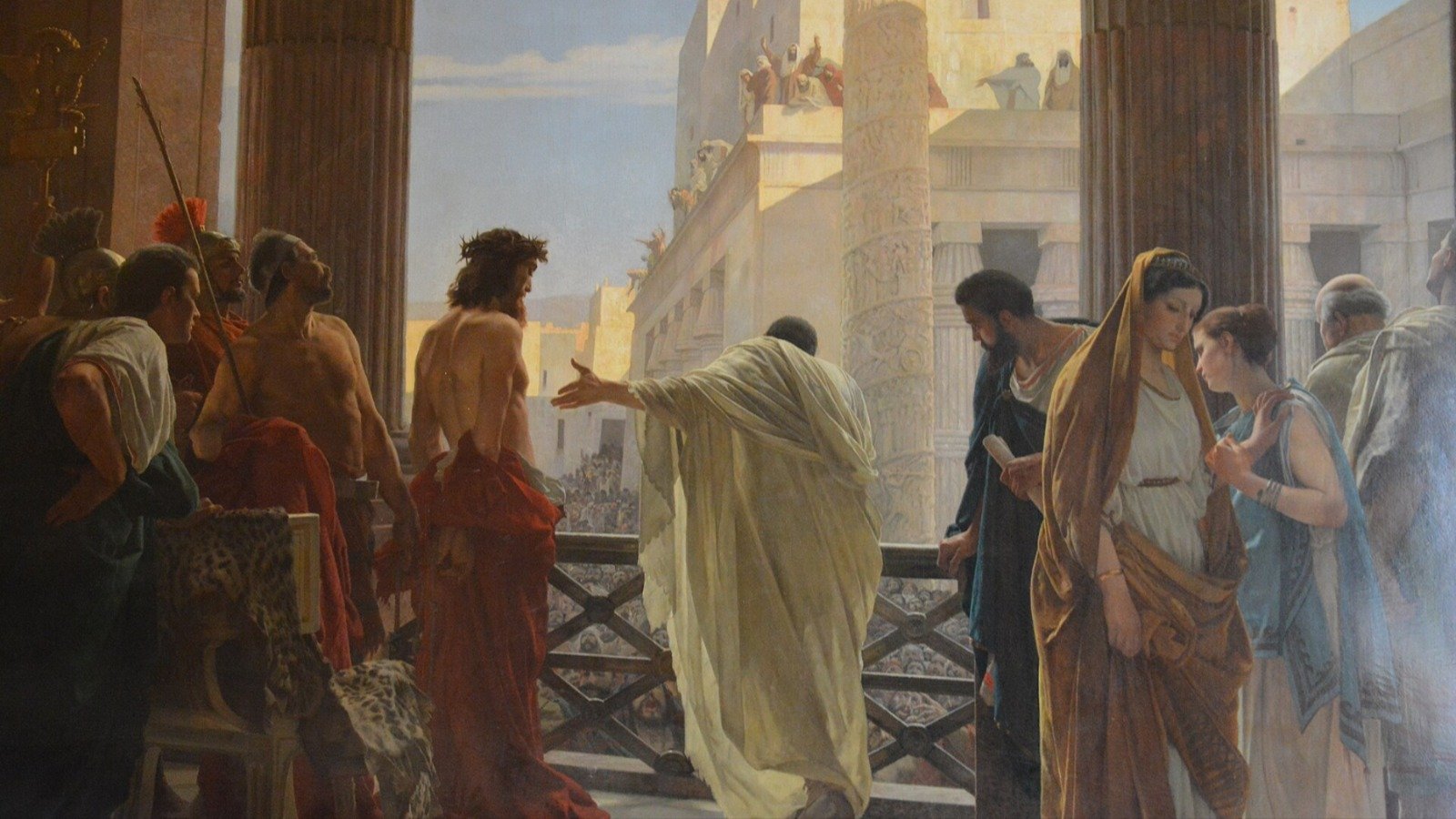
Pilate recoiled from sending an innocent man to a Roman cross. Yet he gave in to Caiaphas and his fellow priests. He allowed a crown of thorns to be pressed on Jesus’ head and a purple robe of mockery to be thrown over the Son of God, as if He were a false king.
We come again to one of the greatest conversations in Scripture. Pilate asked Jesus, “Whence art thou?” But Jesus was silent. Pilate grew angry: “Speakest thou not unto me? knowest thou not that I have power to crucify thee, and have power to release thee?” (John 19:9, 10). And Jesus answered:
“Thou couldest have no power at all against me, except it were given thee from above: therefore he that delivered me unto thee hath the greater sin.” (John 19:11)
By this Jesus meant Caiaphas and the Sanhedrin, who claimed to speak for God in the Jewish nation and were now putting God’s Son to death. Caiaphas was ignoring all the prophecies of the Redeemer in Isaiah, in the Psalms and in the rest of the Old Testament. And he chose, for himself and his people, a Roman Caesar in place of the God of heaven (John 19:15).
Pilate then washed his hands, saying, “I am innocent of the blood of this just person” (Matthew 27:24). And the words of Caiaphas and the people rose to the very throne of God: “Crucify him, crucify him” (John 19:6), and “His blood be on us, and on our children” (Matthew 27:25).
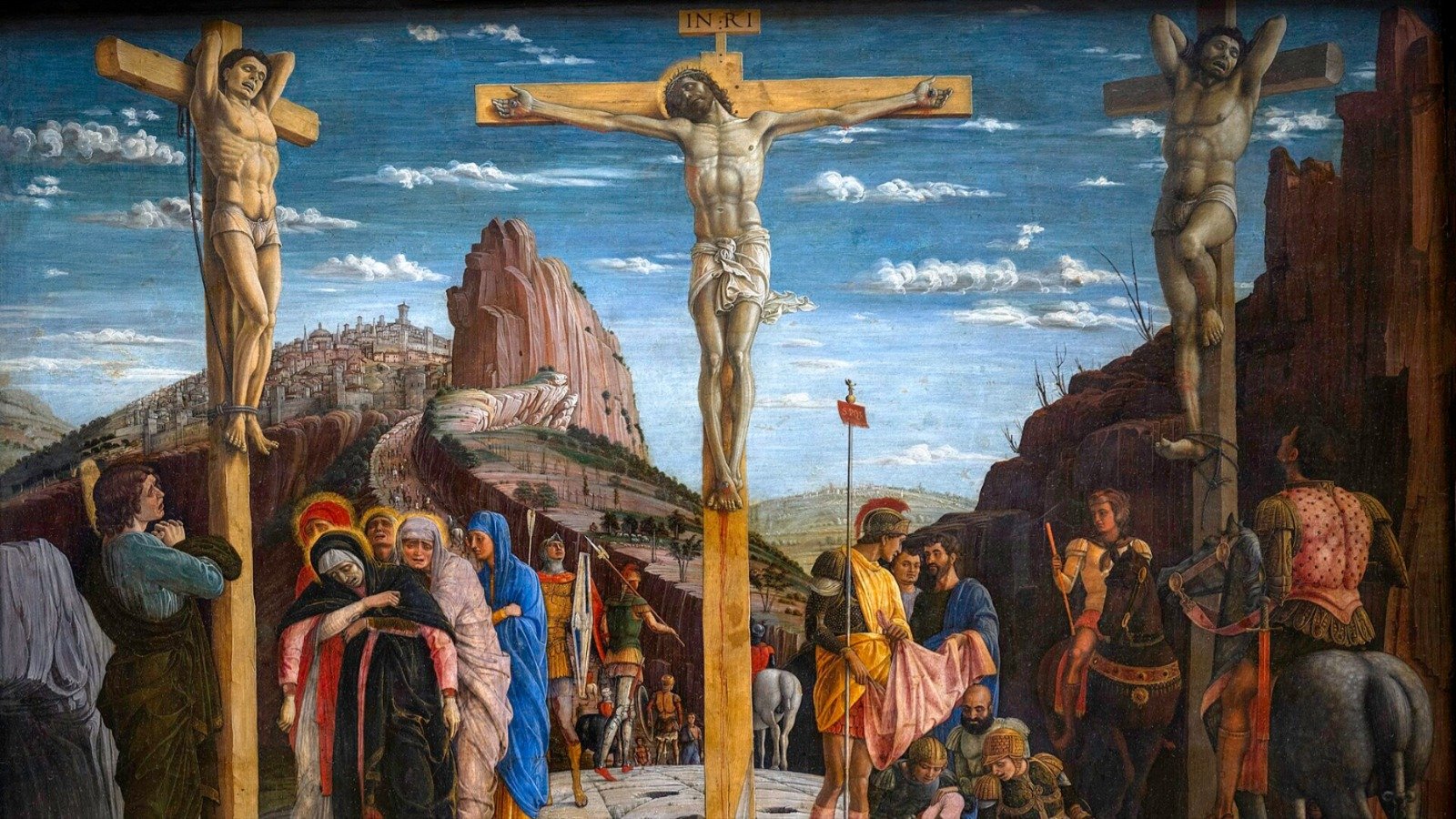
So the Son of God was pushed and dragged through the streets of Jerusalem and nailed to a cross on Calvary’s hill, there to die for your sins and mine. How can we understand what really happened there?
The just for the unjust
A modern story, I think, helps us to do just that.
Enrique was married to Maria. It was New York City. They were Italian, and they were passionately in love. One day Enrique heard rumours that Maria was having an affair. He confronted her, but she denied it.
One winter evening after work, his car would not start. It was very cold and snowing, so he took the subway home and decided to deal with that wretched car in the morning. He came out at the stop nearest their apartment and started down the street. As he passed a restaurant, he looked through the window, and there at the back he saw his wife Maria sitting with a Scandinavian-looking man. They were holding hands across the table, gazing into each other’s eyes, their knees touching. He walked on home a broken man. A terrible wrong had been done to him, but he loved her so much. He could not imagine living without her. How could he get her back?
She came home late that night, but he said nothing. He cried himself to sleep. In a very real way, he was now the bearer of her sin. Finally she spoke: “I am moving out.” She gave him back her ring. He said, “You do not have to move out. We can fix this.”
She said, “I am carrying this man’s baby.” Then she moved out. Enrique was despondent. He did not know how he could go on. He could not concentrate at the office. He was carrying the terrible burden of her sin. Just before the baby was due, Maria’s Norwegian lover abandoned her and was nowhere to be found. And there was another problem for Enrique and Maria, who were olive-skinned Italians: everyone would know the baby was not his.
The time came for the baby to be born. Enrique could not help himself. He went to the hospital to be with Maria. He was bearing her sin. The just must do something for the unjust.
He brought her flowers and said, “If you will come back home with the child, that little boy will be my little boy. You can give him my name, and he will be my child. Maria, I will stand by your side.”
Maria said, “Enrique, I have hurt you too much. I have wronged you so terribly.”
Enrique answered, “Maria, I have borne your wrong. I have suffered your wrong. I forgive you. I forgive you.”
Maria said, “I cannot live with you as a policeman watching over me, or as if you would lord it over me.”
Enrique said, “I will treat you as an equal. I have borne your wrong. I will stand by your side.” Enrique had entered into her pain, and he had also entered into the consequences of her sin. Maria still seemed to waver. Then he reached into his pocket, took out a new ring, placed it on her finger and said, “With this ring, I thee wed.” The new covenant was sealed. His mercy, his love, his kindness, his forgiveness and his understanding broke her heart, and they had a powerful effect on her.
As the little boy grows up, he does not look like Enrique. But make no mistake about it: Enrique is his father. By standing with Maria, he took away her guilt and her shame.
This is just what Jesus has done for us. “For Christ also hath once suffered for sins, the just for the unjust, that he might bring us to God” (1 Peter 3:18). Our Saviour was at home among people who knew they were sinners and whose hearts longed to be forgiven and to know the truth.
When they brought the woman taken in adultery to Him at the temple, Jesus saved her for the kingdom. He wrote in the dust of the ground, and her accusers slipped away one by one. Then He asked her, “Woman, where are those thine accusers? hath no man condemned thee?” She said, “No man, Lord.” And Jesus said, “Neither do I condemn thee: go, and sin no more” (John 8:10, 11). Your sins are gone. I will bear them.
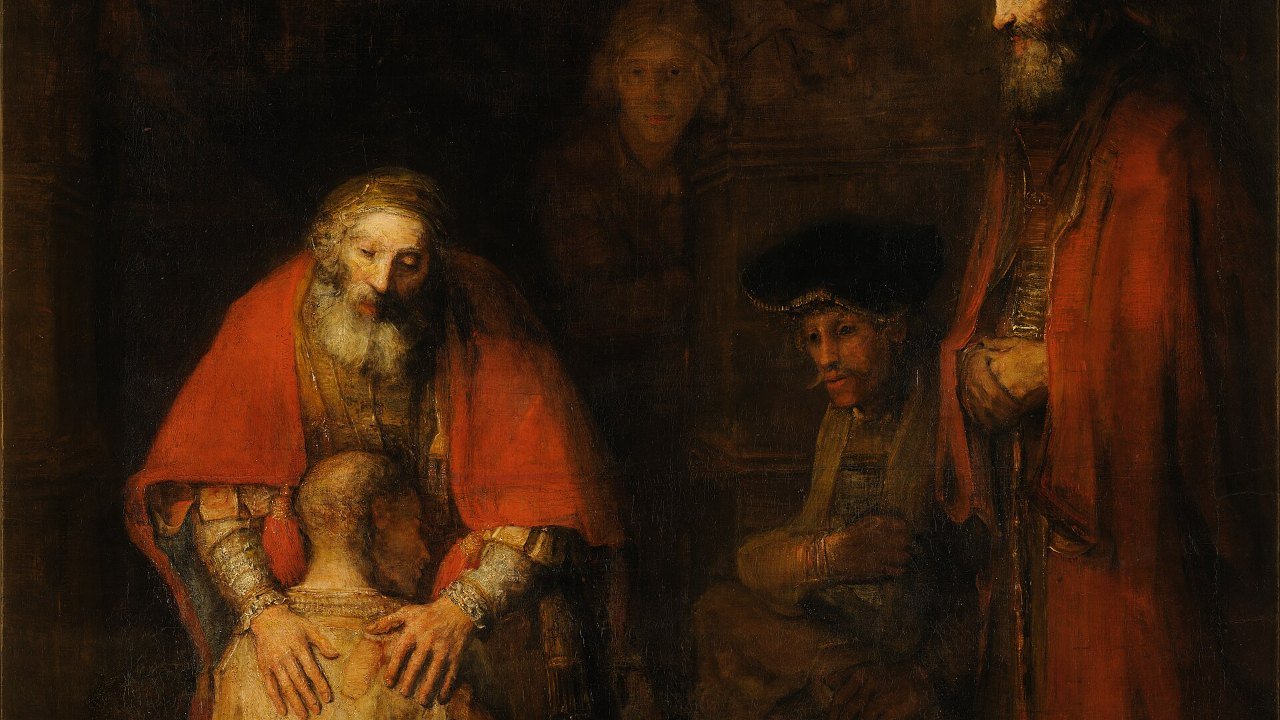
When the prodigal son came home, in the story Jesus told, the father did not wait for him at the front door. He ran out to meet him and called for the best robe, shoes for his feet and a ring for his hand, announcing, “For this my son was dead, and is alive again” (Luke 15:22–24). The father was saying, I have borne his sin, and I have forgiven it.
Welcome home
Throughout eternity in the heavenly land, every time we look at Jesus we will see the scars on His brow from the thorns, and the scars in His hands and His feet. He has borne our sin. He has forgiven us.
These words will never grow old. They are as new as when the apostle John first wrote them on the island of Patmos: “And they shall see his face; and his name shall be in their foreheads” (Revelation 22:4). Jesus bears our scars on His brow, and His name is written in our foreheads and in our minds. Until Jesus comes in the clouds, we can hold this promise securely in our minds.
John writes further from Patmos:
“And God shall wipe away all tears from their eyes; and there shall be no more death, neither sorrow, nor crying, neither shall there be any more pain: for the former things are passed away. And he that sat upon the throne said, Behold, I make all things new.... I will give unto him that is athirst of the fountain of the water of life freely.” (Revelation 21:4–6)
Who can resist this invitation? Who can turn away from an invitation to a supper in heaven with Jesus as the host, saying, “Welcome home, children. Come and enjoy eternity with Me forever”?
Cover: Antonio Ciseri, Ecce Homo (1871). Public domain.
Scripture quotations are from the King James Version.
Take it further
Did this speak to you? Ask for more, or ask us to pray with you.
What's Your Reaction?
Comments 0
No comments yet. Be the first to share a thought.